
Review: Sold on Virginia Stage’s brave ‘The Heart Sellers’
On Thanksgiving Day 1973, 2 immigrant women find a bond in their desolate homesickness. Page Laws reviews.
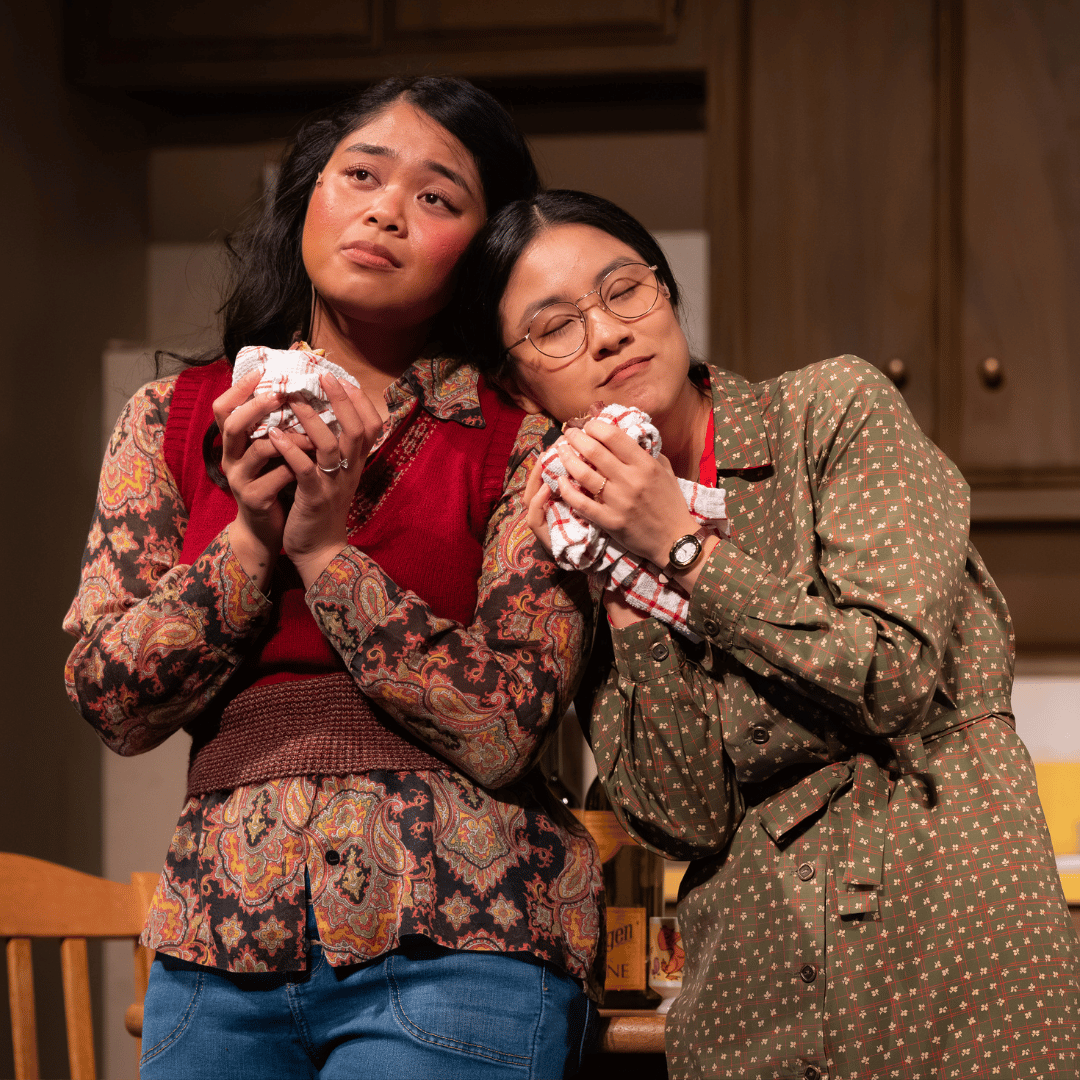
In Virginia Stage Company's production of "The Heart Sellers," about two desperately lonely and heartsick women immigrants in 1973, Luna (Angeleia Ordoñez, left) and Jane (Bridget Kim) eat yams hot from the oven. (Courtesy/J. Stubbs Photography)By Page Laws | Correspondent
PUBLISHED: October 20, 2026 at 11:43 AM EDT
“The Heart Sellers” — an odd and ambiguous title for a play, yes?
So, first off the bat, please note that this is not a Virginia Stage Company two-hander about the illegal trade in human organs for transplants.
It is, instead, a multilevel pun on the Hart-Celler Act, signed into law in 1965 by Lyndon Johnson. It ended the national quota system that, by law, severely limited immigration from Southern and Eastern Europe as well as Asia and Africa. Thus were finally scuttled laws enacted since Colonial times that favored white Western Europeans and their descendants over all other racial groups, and the 1965 action “changed the face of America,” notes the Gilder Lehrman Institute of American History.
How might all this be conveyed by a two-woman play on a small, simple set at Norfolk’s Wells Theatre?
Well, our two women of interest are studies in contrasts, but mostly similarities.
They hail from very different countries in the Asia Pacific. First, we have Jane, an initially very reserved South Korean woman played by Bridget Kim, a Korean American actor from Eastern Kentucky. Then we have Luna, a Filipina played by the exceptionally endearing Angeleia Ordoñez who, from Hawaii, is the daughter of two immigrant parents from the Philippines.
In our play, both are married to immigrant men from their own countries of origin who appear only in discussions about the two wives’ feelings of isolation in America. Both are marvelous in their parts. Luna has a bit of a home-court advantage in being in her own small apartment in a “mid-sized U.S. city” (playwright Lloyd Suh’s instructions to our imaginations). The time is Thanksgiving Day 1973. As the playbill helpfully reminds us, it’s been only five days since President Richard Nixon declared with virtuous (if false) solemnity, “I am not a crook.”
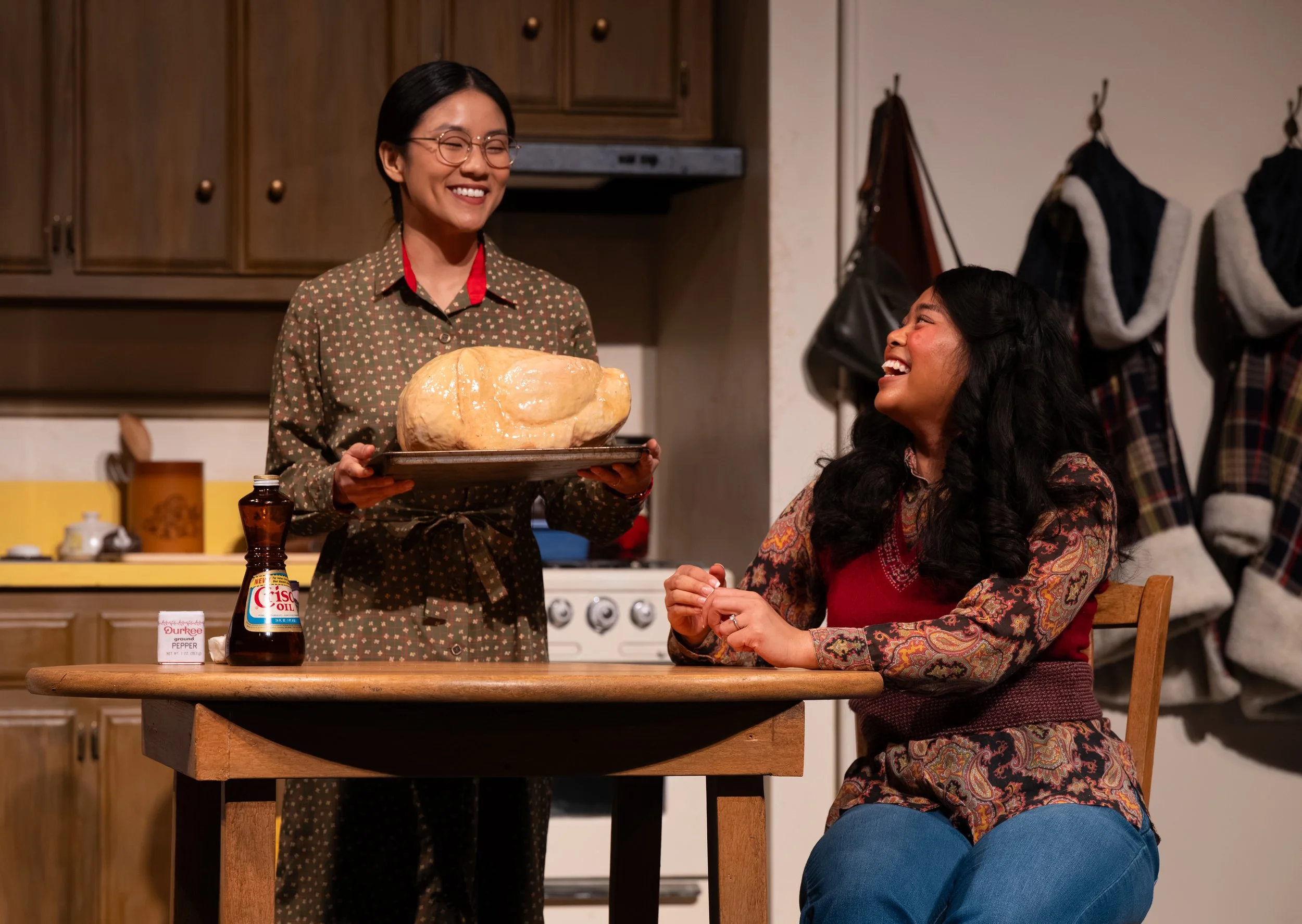
Jane, left, played by Bridget Kim, presents a perpetually frozen turkey to Luna (Angeleia Ordoñez) on Thanksgiving Day 1973. (Courtesy/J. Stubbs Photography)As a production, the play is meant to be small and relatively inert: a tiny, claustrophobia-inducing apartment set within the Wells’ larger stage space. Suh economically re-creates the era with mentions of the women’s favorite TV shows and stars, including “The Price is Right,” “The Young and the Restless,” “Sanford and Son,” Walter Cronkite, Archie Bunker and “Sesame Street.”
We also have a Thanksgiving theme (including a very frozen turkey to be cooked); hence Jane’s visit to Luna’s. The holiday, of course, is often a symbol of white Americans’ giving copious thanks to a white God for their advantages while other ethnicities politely play along. (This is the same theater and stage that gave us Larissa FastHorse’s take, “The Thanksgiving Play,” in 2022. There are rich parallels to draw between the two shows — though not right here, for lack of oven space.)
But let’s proceed to the more important parallels (between our two recent immigrant women) that make this two-hander so revealing. Here are some of them.
Both women hail from countries suffering under dictatorial rule. Luna, our chatty Filipina, comes from an island nation economically laid waste by Ferdinand Marcos and family. Jane, our more taciturn South Korean, has similar political strife back at home. Both women have married men they did not love in order to emigrate to the U.S. Both husbands work at jobs that utterly preoccupy them, leaving their brides bereft of company as well as love.
Both women love to shop at Kmart (one point for the USA) and there they have unknowingly bought identical plaid winter coats, which they wear on Thanksgiving. This is Jane’s first visit to Luna’s home, and it’s awkward from the get-go. Eventually she will warm to her host, aided by one, and then a second, bottle of wine they slug down. They discover that they both love “Soul Train” and hate Nixon. Both have beloved communist sisters back in their countries of origin, though Jane’s was “killed by a bus” (according to the anticommunist authorities who reported her death). Both women discuss the differing sensations — smells, sights, weather — in their home countries vis-à-vis the U.S.
Both women are desperately lonely and visibly, physically relieved to be able to share, at long last, some of their anguished homesickness and desolation.
We learn that the women once had their own career interests — Jane as a painter and Luna as a singer. Luna later belts out an incredibly sweet and sonorous version of a Filipino song in Tagalog. (Director Desdemona Chiang later explained that the song is titled “Ikaw” and was originally sung by Yeng Constantino, a Filipina pop star.) This suddenly discovered mutual interest in the arts seems a bit unlikely as a plot element. But the song is even more welcome for being a total surprise.
Luna will eventually confess to terrible loneliness and depression, to the point that Jane must rein in her new friend, getting her off the emotional ledge. Fortunately, the women’s new bond seems solid enough to promise a less lonely existence in the future for both. Luna speaks of a rather dreamlike vision of rural American bliss she once had. This plot point, also, seems a bit contrived beyond necessity and believability.
But overall, the play and performers give convincing, truthful depictions of the suppressed (by men) and repressed lives some women immigrants must either endure or overcome.
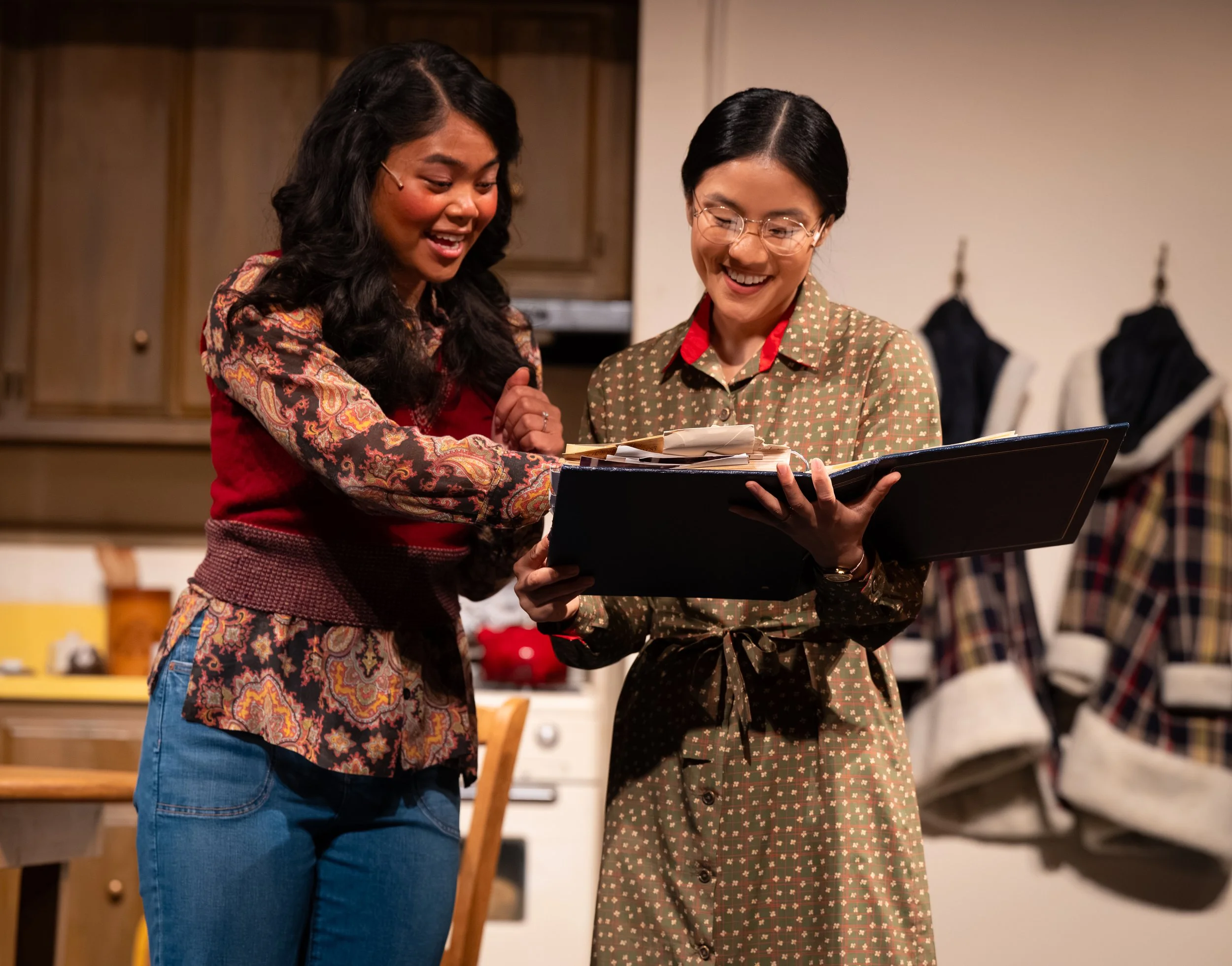
Luna, left, played by Angeleia Ordoñez, shows a scrapbook to Jane, played by Bridget Kim. (Courtesy/J. Stubbs Photography)Suh, a second-generation Korean American, also possesses a wonderful feel for the mistakes in English that many nonnative speakers make, especially as they’re still mastering their new language. These grammatical gaffes are balanced by the women’s surprising fluency in a language that even we native speakers mess up all the time.
Director Chiang (who emigrated from Taiwan as a child, following her parents) uses her own familial experience to stand up for these later-arriving, “post-founding” mothers and fathers of America.
One of Suh’s most felicitous inventions deserves a parting mention. Luna reports that she and her husband planned to go to Disneyland for their honeymoon on arriving in the U.S. But one small detail arose once they approached the Magic Kingdom: They couldn’t afford the hefty admission.
They therefore spent their precious honeymoon intermittently standing and looking over the gates to get a glimpse of Disney’s world-renowned attractions. So near and yet so far away, that much ballyhooed, Disneyfied American Dream. When you wish upon a star (or, in this case, the Stars and Stripes), sometimes your wishes can’t come true.
Come see the play (from inside the Wells Theatre, using a reasonably priced ticket) and consider yourselves privileged and blessed, which some of us most certainly are and all of us should be.
Page Laws is dean emerita of the Nusbaum Honors College at Norfolk State University.
If you go
When: 7:30 p.m. Tuesday through Friday, 2 and 7:30 p.m. Saturday, and 2 p.m. Sunday
Where: The Wells Theatre, 108 E. Tazewell St., Norfolk
Tickets: Start at $15; a pay-what-you-can option is available for Tuesday’s performance
