Mark Shanahan's A Sherlock Carol brings together the beloved worlds of Charles Dickens and Sir Arthur Conan Doyle. But tucked away in the play are dozens of literary references, familiar characters, borrowed lines and playful nods to the original stories.
Some are obvious. Others require the keen observational skills of Sherlock Holmes himself!
How many can you spot as you watch the play?
1. “Moriarty was dead, to begin with.”
The opening line of the play echoes one of the most famous opening lines in literature: “Marley was dead: to begin with,” from Dickens' A Christmas Carol.
2. The Blue Carbuncle
The missing jewel at the heart of our mystery comes directly from Doyle's The Adventure of the Blue Carbuncle, a Sherlock Holmes adventure that also takes place at Christmastime.
3. The Countess of Morcar
The original owner of the Blue Carbuncle in Doyle's story is the Countess of Morcar. In our play, she has a rather intriguing personal history!
4. Irene Adler
The celebrated American opera singer who outwitted Sherlock Holmes in A Scandal in Bohemia makes a return appearance. Holmes famously knows her as “the woman.” Even her New Jersey origins are taken from Doyle, who tells us that Irene Adler was born there in 1858.
5. Mrs. Dilber
Scrooge's housekeeper takes her name from the laundress who appears briefly late in Dickens' novella, selling the belongings of the deceased Scrooge.
6. Fannie Gardner
Scrooge's grandniece is named in honor of her grandmother, Fan, Ebenezer's beloved sister, whom we meet during his journey with the Spirit of Christmas Past.
7. The Face in the Doorknocker
When Holmes sees Scrooge's face in a doorknocker, he experiences precisely the sort of supernatural encounter Scrooge once had with Jacob Marley.
8. The Fezziwig Christmas Party
Ralph and Abigail Fezziwig are members of the family whose Christmas festivities were made famous by Scrooge's kindly former employer, Old Fezziwig. Apparently, the family tradition continues!
9. “Come here, and know me better, man!”
Scrooge's invitation to Sherlock Holmes is borrowed directly from the Spirit of Christmas Present.
10. “You have been to Afghanistan, I perceive.”
These are among the very first words Sherlock Holmes ever speaks to Dr. Watson in Doyle's first Holmes novel, A Study in Scarlet, published in 1887.
11. Mary Morstan
Dr. Watson's wife first appeared in Doyle's second Sherlock Holmes novel, The Sign of the Four, in which she seeks Holmes' assistance and captures Watson's heart.
12. The Deerstalker Hat
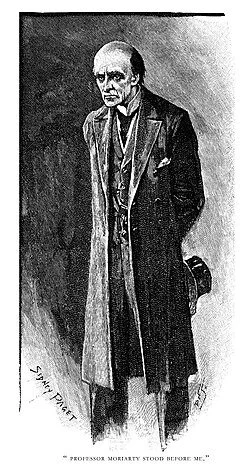
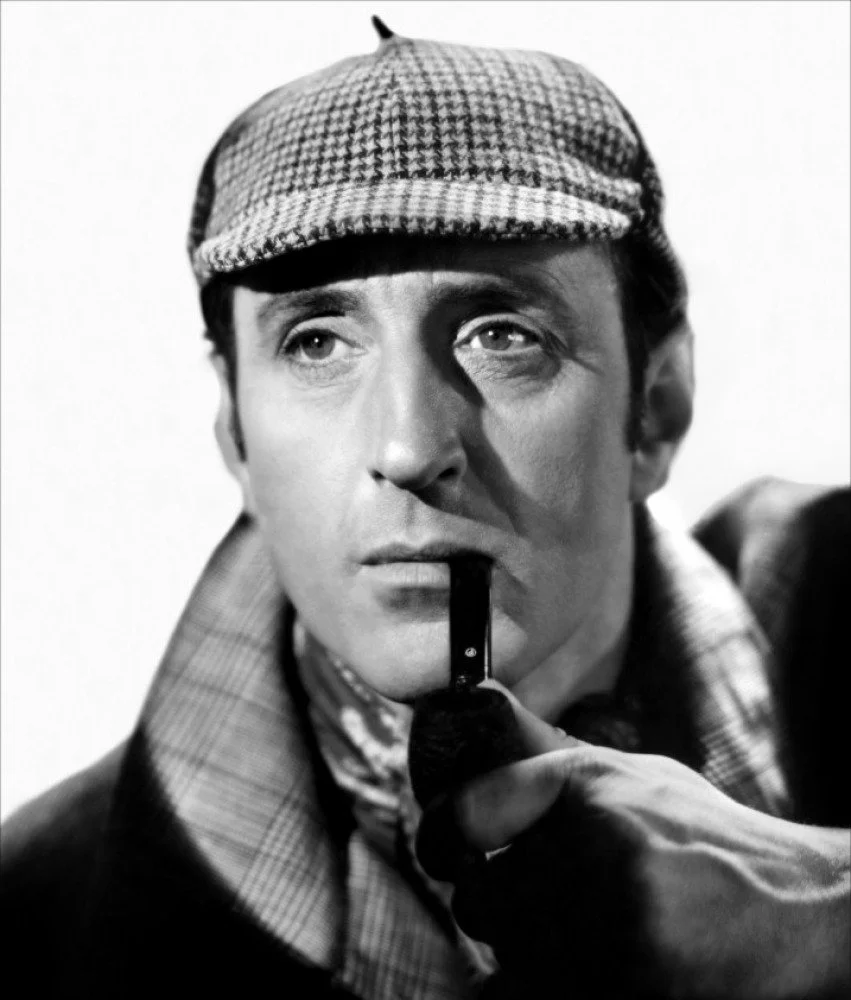
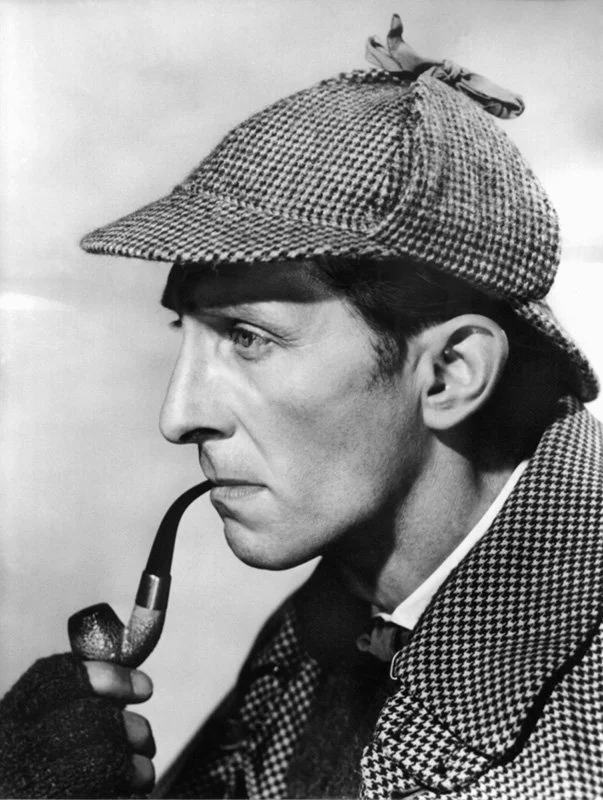
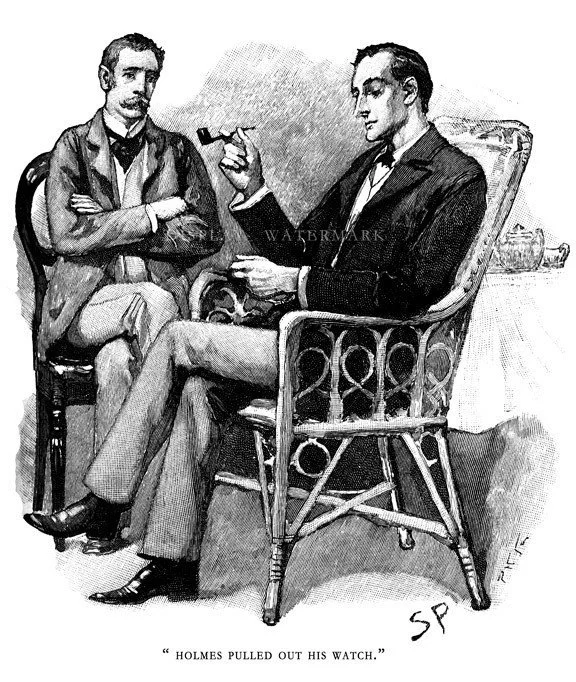
In the play, Holmes objects to the famous image of himself in a deerstalker. Interestingly, Doyle never specifically calls Holmes' hat a deerstalker. We largely have the original illustrator, Sidney Paget, to thank for that iconic image, which he popularized in his illustrations accompanying the Sherlock Holmes stories in The Strand Magazine. In our play, Holmes complains that Watson's accounts of his adventures in The Strand Magazine bear little resemblance to the man himself.
13. Constable Bradstreet
Even the policeman who makes a brief appearance in our play has a literary pedigree. Bradstreet appears in several Doyle adventures, including The Man with the Twisted Lip.
14. Old Joe Brackenridge
Two literary characters rolled into one! Old Joe is the dealer in secondhand goods in A Christmas Carol, while Breckinridge is the goose salesman in The Adventure of the Blue Carbuncle. A Sherlock Carol suggests both men are one and the same!
15. The Wiggins Family
Emma Wiggins and her father, Bill, are inspired by Wiggins, the young leader of Holmes' Baker Street Irregulars, first introduced in A Study in Scarlet.
16. Mr. Topper
The manager of the Cosmopolitan Hotel is the same character who is seen as a guest at Fred's Christmas party in Dickens' novella. Topper was quite a flirt and a bit of a blowhard even in Dickens' day!
17. Mr. Henry Burke
Our Irish candlemaker is a reimagining of Henry Baker, the unfortunate gentleman who loses both his hat and his Christmas goose in The Adventure of the Blue Carbuncle.
18. Mrs. Windigate and the Goose Club
The proprietor of the Alpha Inn and the curious tradition of a Christmas Goose Club come straight from The Adventure of the Blue Carbuncle. Doyle's innkeeper, however, is a Mr. Windigate.
19. The Words of Belle
Listen carefully when Scrooge recounts his encounter with Irene Adler. His words, “I release you” and “May you be happy in the life you choose,” echo those spoken to him by his former fiancée, Belle, in A Christmas Carol.
20. “There is nothing in the world so hard as poverty.”
Scrooge says this to Irene Adler in our play, but he originally spoke these words as a much younger man during his heartbreaking conversation with Belle in Dickens' novella.
21. “Mankind is your business!”
Scrooge's admonishment to Holmes echoes the lesson Jacob Marley once taught him: “Mankind was my business.”
22. “When you have eliminated the impossible...”
One of Holmes' most famous principles of deduction, first expressed in The Sign of the Four, is turned back upon the detective himself by the spirit of Ebenezer Scrooge.
23. “There is nothing new under the sun.”
Holmes' weary observation also appears in A Study in Scarlet. The expression itself is considerably older than Sherlock Holmes, originating in the Book of Ecclesiastes.
24. “Are these the shadows of things that will be?”
When Holmes is confronted with a vision of his future, he asks the very same question Scrooge once asked the Spirit of Christmas Yet to Come. Can the future still be changed?
25. “God bless us, everyone!” and the Cratchit Family
Perhaps the most beloved line in all of Dickens. In A Sherlock Carol, Tiny Tim has grown up to become Dr. Timothy Cratchit, but his generous spirit remains very much intact. His older sister Martha also appears in Dickens' original novella. In our play, she is very much her mother's daughter, outspoken, practical, fiercely protective of her family and still more than a little suspicious of Ebenezer Scrooge! She also retains her playful nature and love of playing games with children, just as she did with her younger siblings in Dickens' original Christmas Day scene. And, like her mother before her, Martha takes great pride in preparing a Christmas feast.
26. “Solitary as an oyster.”
The description of Sherlock Holmes at the beginning of our play is borrowed directly from Dickens' description of Ebenezer Scrooge. Holmes is also described as “hard and sharp as flint,” just as Scrooge once was.
27. A Melancholy Meal
When we first encounter Holmes dining alone, he is taking his usual melancholy meal in his usual melancholy tavern. Dickens uses almost exactly the same words to describe Scrooge's lonely Christmas Eve dinner.
28. “The Napoleon of Crime.”
Holmes' description of Professor Moriarty comes from Doyle's The Final Problem, the story in which the detective confronts his greatest adversary at the Reichenbach Falls.
29. The Year 1894
There's a very good reason A Sherlock Carol takes place in 1894. According to Doyle's The Adventure of the Empty House, this is the year Holmes returned to London after the world had presumed him dead for three years.
30. Beeton's Christmas Annual
Scrooge reveals that he's been reading Watson's adventures since their very first publication in Beeton's Christmas Annual. This was indeed the magazine in which A Study in Scarlet first appeared in 1887. Sherlock Holmes made his literary debut in a Christmas publication!
31. “I said good afternoon!”
When Holmes dismisses Watson and refuses his invitation to Christmas dinner, he borrows a favorite expression from Scrooge. In Dickens' novella, Scrooge repeatedly dismisses his nephew Fred with a curt “Good afternoon!”
32. “What cause have you to be dismal?”
The challenge to Holmes' gloomy outlook on Christmas echoes the exchange between Scrooge and his nephew Fred at the beginning of A Christmas Carol.
33. The Unwelcome Christmas Caroler
Holmes' encounter with a Christmas caroler at the beginning of the play recalls Dickens' original story, in which Scrooge frightens away a young caroler who attempts to sing outside his counting-house.
34. The Cosmopolitan Hotel
The hotel managed by Mr. Topper in our play is not an invention of the playwright. It is the very hotel from which the Countess of Morcar's precious jewel is stolen in The Adventure of the Blue Carbuncle.
35. The Streets of Victorian London
Listen for Wimpole Street, Wigmore Street, Oxford Street and Baker Street. The geography of Holmes' London is part of the fabric of Doyle's stories. The route through Wimpole, Wigmore and Oxford streets is particularly reminiscent of Holmes and Watson's journey in The Adventure of the Blue Carbuncle.
36. The Bed Curtains
Old Joe's dealings in secondhand bed curtains are a nod to one of the darkest scenes in A Christmas Carol, in which the Ghost of Christmas Yet to Come shows Scrooge his possessions being sold after his death. Even the curtains surrounding his deathbed have been taken!
37. “Ask me who I was.”
When Holmes asks the ghostly Scrooge who he is, Scrooge gives precisely the same answer Jacob Marley's ghost once gave him.
38. “Why do you doubt your senses?”
Scrooge asks Holmes this question when the detective refuses to believe in ghosts. It is the very question Marley asks Scrooge when he refuses to believe in him.
39. “My business is your welfare! And your reclamation.”
Scrooge borrows these words from the Ghost of Christmas Past, who arrives to help him understand the mistakes he has made in his life.
40. Boiled with His Own Pudding
When Scrooge recalls his former hatred of Christmas, he repeats his famous declaration that anyone who goes about with “Merry Christmas” on his lips should be boiled with his own pudding and buried with a stake of holly through his heart. The speech comes directly from the first stave of Dickens' novella.
41. The Chains Moriarty Forged in Life
Scrooge explains that Professor Moriarty is condemned to wear the chains he forged in life, link by link. His description echoes Jacob Marley's explanation of the terrible chains he must carry through eternity.
42. Prisons and Workhouses
Holmes' bitter description of a world filled with prisons and workhouses recalls Scrooge's infamous response to the gentlemen collecting money for the poor: “Are there no prisons?” and “And the Union workhouses?”
43. A Kind and Charitable Time
When Scrooge defends Christmas as a kind and charitable time and a season of forgiveness, he is echoing the beautiful speech his nephew Fred once delivered to him. Clearly, Scrooge was listening after all!
44. “We might as well know the worst of each other.”
During Holmes' recollection of his first meeting with Watson, he admits that he sometimes gets in the dumps and doesn't speak for days. This surprisingly candid admission comes directly from A Study in Scarlet, when the two men are considering sharing lodgings.
45. “The best and wisest man I have ever known.”
Watson's moving tribute to Holmes is borrowed from the closing words of The Final Problem, written when Watson believed his dear friend had perished at the Reichenbach Falls.
46. “A conductor of light.”
Holmes' affectionate description of Watson as a conductor of light comes from The Hound of the Baskervilles. Doyle's detective acknowledges that Watson's great gift is his ability to inspire brilliance in others.
47. “His offenses carry their own punishment.”
When Watson defends Holmes despite his friend's unkind behavior, he borrows the words of Fred, who refuses to speak ill of his Uncle Scrooge during his Christmas party. Both men understand that their unhappy friends are hurting themselves most of all.
48. “Men's courses will foreshadow certain ends.”
When Holmes begs Scrooge to tell him whether the future can be changed, the two characters share dialogue originally spoken by Scrooge himself to the silent Ghost of Christmas Yet to Come. Dickens' belief that we can change our destiny by changing our behavior becomes a central theme of Holmes' adventure.
49. The Boy Who Bought the Christmas Turkey
Remember the unnamed boy whom Scrooge sends to purchase the enormous prize turkey on Christmas morning in A Christmas Carol? A Sherlock Carol offers a playful suggestion as to who that boy might have grown up to become. Listen carefully near the end of the play!
50. “He was better than his word.”
The closing narration of A Sherlock Carol borrows from the final paragraphs of Dickens' novella. Just as Scrooge became as good a friend and as good a man as the good old city knew, Sherlock Holmes is given the opportunity to become the very best version of himself.
51. Dead as a doornail.
When Scrooge acknowledges his own demise, he borrows an expression from the opening paragraph of A Christmas Carol. Dickens famously spends several sentences contemplating why a doornail should be considered particularly dead!
52. Nothing Wonderful Can Come of the Story
The company insists that Moriarty's death must be distinctly understood before our story can begin. Dickens makes precisely the same argument about Marley's death in the opening pages of his novella.
53. “Once upon a time, of all the good days of the year...”
The company's introduction to Christmas Eve in London recalls Dickens' description of the day on which Scrooge's extraordinary adventure begins.
54. The Fog at Every Keyhole
The fog that pours in at every keyhole at the beginning of our play comes from Dickens' description of the bitterly cold Christmas Eve in the first stave of A Christmas Carol.
55. The Chattering Clocks
Even the description of the city clocks chattering as they strike one o'clock has its origins in Dickens' wonderfully atmospheric description of Christmas Eve in Victorian London.
56. Watson's Christmas Visit and Invitation to Dinner
Watson's Christmas encounter with Holmes recalls the opening of The Adventure of the Blue Carbuncle, in which Watson calls upon his friend Sherlock Holmes during the Christmas holidays. But the scene also owes a great deal to Dickens. When Watson invites his reluctant friend to Christmas dinner, he assumes much the same role as Scrooge's cheerful nephew Fred, who refuses to let his uncle's ill temper discourage him from extending an invitation. Both men remain remarkably generous in spirit, even in the face of rejection.
57. 221B Baker Street
Perhaps the most famous fictional address in literature! Holmes and Watson first take up residence together at 221B Baker Street in A Study in Scarlet. Their rooms have since become almost as famous as the detective himself.
58. Mrs. Hudson
Holmes' long-suffering landlady is another familiar figure from the original stories. Mrs. Hudson appears throughout Doyle's adventures and has witnessed some decidedly peculiar goings-on at Baker Street.
59. Inspector Lestrade
Holmes' frequently bewildered colleague from Scotland Yard has been part of the Sherlock Holmes stories since the very beginning, appearing in A Study in Scarlet. His professional relationship with Holmes is one of the great recurring pleasures of Doyle's stories.
60. The Consulting Detective
Holmes' professional title is inspired by his explanation of his unusual occupation in A Study in Scarlet. He describes himself as a consulting detective, a profession he has essentially invented for himself.
61. The Mastermind of the Criminal Underworld
The depiction of Moriarty as the mastermind behind London's criminal activities recalls The Final Problem, in which Holmes describes the Professor as a spider sitting motionless at the center of an enormous criminal web.
62. The Reichenbach Falls
Holmes' anguish over the loss of his greatest adversary stems from the events of The Final Problem. The famous waterfall in Switzerland is a real place and remains a destination for Sherlock Holmes enthusiasts.
63. The Fiddle
Holmes complains that Watson depicts him as an eccentric detective with a fiddle. His musical abilities are well established in Doyle's stories, beginning with A Study in Scarlet. His violin playing is not always appreciated by his roommate!
64. The Comical Pipe
Although Holmes smokes several kinds of pipes in Doyle's stories, the distinctive curved pipe associated with the detective owes much to theatrical tradition, particularly the celebrated stage portrayal of Holmes by American actor William Gillette.
65. Holmes' Seven Percent Solution
Holmes' objection to Watson's depiction of his eccentricities recalls some of the more troubling aspects of Doyle's original character. The Sign of the Four famously begins with Watson expressing concern about Holmes' drug use- in particular his use of a seven percent solution of cocaine.
66. Camden Town
Holmes deduces that Dr. Cratchit grew up in Camden Town by listening to his accent. Dickens specifically identifies Camden Town as the neighborhood in which the Cratchit family lives.
67. Tiny Tim's Cane
The grown-up Timothy Cratchit still walks with the assistance of a cane. In Dickens' novella, the young Tiny Tim carries a little crutch and wears an iron frame to support his limbs.
68. A Second Father to Tiny Tim
Dr. Cratchit speaks of Ebenezer Scrooge as a second father to him. Dickens tells us in the final pages of A Christmas Carol that Scrooge became a second father to Tiny Tim, who did not die.
69. An Unexpected Guest for Christmas Dinner
When a transformed Sherlock Holmes arrives at Watson's home to apologize and accept his friend's invitation to Christmas dinner after all, he is following in the footsteps of Ebenezer Scrooge. In the final stave of Dickens' novella, a newly reformed Scrooge appears unexpectedly at his nephew Fred's home, asking forgiveness and hoping he might join the Christmas festivities. In both stories, the simple act of knocking on a friend's door becomes a moving demonstration of a man's change of heart.
70. “A squeezing, wrenching, grasping, scraping, clutching, covetous old sinner...”
When Dr. Cratchit describes the man Scrooge once was, he borrows one of Dickens' most wonderfully colorful descriptions of his famous miser.
71. The Newspaper Clippings
The mysterious threatening letter Scrooge receives is assembled from words cut from a newspaper. Holmes encounters a similarly constructed anonymous warning in The Hound of the Baskervilles, even identifying the newspaper from which the words were taken.
72. The Agony Column
Holmes identifies the source of the words in Scrooge's mysterious letter as the agony column of The Times. Personal advertisements and cryptic newspaper messages are recurring devices in Doyle's mysteries, including The Adventure of the Red Circle.
73. The Battered Hat
The lengthy examination of a seemingly unremarkable hat is taken directly from The Adventure of the Blue Carbuncle. Holmes deduces that its owner has fallen upon hard times, has been unable to replace his expensive hat for three years, uses lime-cream, has lost his wife's affections and probably has no gas lighting in his home. Even the five wax stains on the hat come from Doyle's original story. In our play, this last clue takes on additional significance because of Henry Burke's profession as a candlemaker.
74. “A most unimpeachable Christmas goose.”
Holmes' description of the goose that becomes part of his investigation echoes Doyle's description of the bird in The Adventure of the Blue Carbuncle.
75. The Initials H.B.
The initials connecting a lost hat to its owner are taken from Doyle's original mystery. By changing Henry Baker to Henry Burke, our play retains this important clue while giving the character an entirely new history.
76. The Extraordinary History of the Blue Carbuncle
Holmes' account of the jewel's origins near the Amoy River in southern China, its weight of forty grains of crystallized charcoal and the sinister history of crimes associated with it all come directly from Doyle's original story. The author gives this tiny object such an elaborate history that it almost becomes a character in its own right.
77. The Goose's Crop
The discovery of a precious jewel inside a Christmas goose comes directly from The Adventure of the Blue Carbuncle. In our play, Martha Cratchit has the distinction of making this extraordinary discovery.
78. The Disjecta Membra
Henry Burke's surprisingly scholarly Latin expression when Holmes offers him the remains of his original goose is borrowed directly from Henry Baker in Doyle's story. It means scattered or dismembered parts. Apparently, both gentlemen are rather well educated!
79. “A fowl fancier myself.”
Holmes pretends to have an interest in poultry in order to discover the origins of the mysterious goose. This amusing little deception is taken directly from his investigation in The Adventure of the Blue Carbuncle.
80. The Museum
The connection between the Alpha Inn and the museum has its origins in Doyle's original story. The Alpha Inn is situated near the British Museum, and Henry Baker explains that many of its patrons are connected with the institution.
81. The Replacement Goose
Holmes purchases another goose to compensate Henry Burke for the loss of his original bird. He makes the same generous gesture toward Henry Baker in Doyle's Christmas adventure.
82. Covent Garden Market
Holmes' investigation leads him to the famous London market, just as it does in The Adventure of the Blue Carbuncle. Doyle's mystery follows the journey of a Christmas goose backward through the city's poultry trade.
83. Helen Stoner
One of the figures from Holmes' past is the young woman who seeks his protection in The Adventure of the Speckled Band. Doyle himself ranked this story as his favorite of the Sherlock Holmes short stories.
84. Dr. Grimesby Roylott
Another figure from The Adventure of the Speckled Band, the formidable Dr. Roylott is one of Holmes' most memorable adversaries. In Doyle's story, he demonstrates his extraordinary strength by bending a fireplace poker with his bare hands.
85. Jabez Wilson
The redheaded pawnbroker from The Adventure of the Red-Headed League makes an appearance in Holmes' memories. His peculiar adventure begins when he is offered a rather unusual job copying out the Encyclopaedia Britannica.
86. Sir Henry Baskerville
The heir to the Baskerville estate appears among the figures from Holmes' past. In The Hound of the Baskervilles, Holmes and Watson must determine whether an ancient family curse has a supernatural or an entirely human explanation. Sound familiar?
87. The King of Bohemia
Among the figures from Holmes' past is Wilhelm von Ormstein, the King of Bohemia, whose attempts to recover a compromising photograph from Irene Adler form the basis of A Scandal in Bohemia.
88. Mycroft Holmes
Sherlock's extraordinary brother is another figure from his past. Mycroft first appears in The Adventure of the Greek Interpreter, in which Sherlock acknowledges that his brother's powers of observation and deduction actually exceed his own.
89. The Stapletons
Listen for the reference to Stapleton during Holmes' journey into his past. The name belongs to one of the most memorable families in The Hound of the Baskervilles, a mystery in which Holmes investigates an apparently supernatural threat.
90. “A small matter, to make you so full of gratitude.”
When Scrooge speaks these words to Irene Adler, he echoes a remark made by the Ghost of Christmas Past after he witnesses the generosity of his former employer, Fezziwig. The exchange reminds us how seemingly small acts of kindness can transform someone's life.
91. “You fear the world too much.”
When Scrooge challenges Holmes' pessimistic view of humanity, he borrows language from Belle, who once challenged the young Scrooge's increasingly fearful and materialistic outlook on life.
92. The Silent Spirit
During Holmes' supernatural encounter with Scrooge, the normally talkative ghost becomes silent and points an ominous finger. His behavior deliberately evokes the silent, mysterious Spirit of Christmas Yet to Come, whose gestures terrified Scrooge in Dickens' novella.
93. “Out upon a Merry Christmas!”
Holmes' disdain for the holiday is expressed in words borrowed directly from Scrooge's argument with his nephew Fred in the opening stave of A Christmas Carol.
94. “The Boswell to Holmes' Johnson.”
In the character descriptions for A Sherlock Carol, Watson is described as the Boswell to Holmes' Johnson. Holmes himself makes this comparison in A Scandal in Bohemia, referring to the celebrated eighteenth-century biographer James Boswell and his friend and subject, Samuel Johnson.
95. “The game is afoot!”
One of Holmes' most famous expressions appears in Doyle's The Adventure of the Abbey Grange. But its literary history goes back even further! Shakespeare uses the expression in Henry V, centuries before Sherlock Holmes made it his own.
96. “Elementary, my dear Cratchit.”
A playful variation on the most famous phrase Sherlock Holmes never actually says in Doyle's original stories: “Elementary, my dear Watson.” Holmes does use the word “elementary” and frequently addresses his friend as “my dear Watson,” but the familiar combination was popularized through later adaptations.
97. “Deep and crisp and even.”
The description of the snow covering London on Christmas morning is borrowed from the lyrics of the Victorian Christmas carol Good King Wenceslas, first published in 1853, ten years after Dickens wrote A Christmas Carol.
98. A Forgotten Grave
When Scrooge shows Sherlock Holmes a vision of the graveyard where the detective may one day lie buried and forgotten, Holmes experiences the same terrifying revelation that Scrooge himself once experienced at the hands of the Spirit of Christmas Yet to Come. In Dickens' novella, Scrooge is horrified to discover his own name upon a neglected gravestone. For both men, the prospect of dying alone and unloved forces them to consider not only how they will die, but how they have chosen to live.
99. The Twelve Days of Christmas
Scrooge's favorite Christmas carol is much more than a bit of festive music. The traditional song, first known to have appeared in print in England in 1780, becomes an integral part of Holmes' investigation. Have you ever stopped to consider how many gifts are actually given over the course of those twelve days? As Scrooge himself likes to say, “It all adds up!” To tell you any more would spoil the fun of solving the mystery.
100. The Ghost Light
At the beginning of A Sherlock Carol, a solitary lamppost stands on an otherwise bare stage, evoking the image of a theatrical ghost light. While this is not a direct reference to Dickens or Doyle, it is a tribute to the theatrical tradition of ghost stories and the enduring power of storytelling. Dickens famously performed A Christmas Carol before live audiences, bringing its many characters to life himself. Our company of actors continues that tradition, conjuring the worlds of Dickens and Doyle before our very eyes.
And these are only 100 of the many literary, historical, musical and theatrical treasures hidden throughout the play. There are plenty more waiting to be discovered!
Happy hunting, and Happy holidays!