
‘Excellent musical theater’ and a backstory of many dreams fulfilled: Page Laws reviews.
In the declining years of Andrew Lloyd Webber’s reign as West End/Broadway composer/producer phenom extraordinaire, why mount one of his and Tim Rice’s earliest musical works at the Virginia Stage Company right now?
That’s what Thomas Quaintance, the company’s artistic and producing director, admits to thinking (though not in those words) when fellow director Billy Bustamante first proposed the idea of doing “Joseph and the Amazing Technicolor Dreamcoat” at VSC. But Quaintance also knew Bustamante’s work from Roald Dahl’s “Matilda: The Musical,” which Virginia Stage presented in Season 40 (2018-19), and from doing “The Hobbit,” directed by Bustamante in Season 44 (2022-23). Quaintance recalled this in a talk-back session after the second preview of “Joseph,” sharing the stage with religious guests Rabbi Michael Panitz of Temple Israel and the Rev. Charles Lane Cowen of St. Andrew’s Episcopal Church, both in Norfolk.
Now that we know Bustamante got his way, and having seen the impressive product itself (excellent musical theater), it’s all become clearer just why and how it all came about.
According to the 1994 vocal selections book for “Joseph,” the show itself, way back at its beginning, started in 1967 as a 20-minute “pop cantata” for Colet Court (now St. Paul’s Junior School) in London. Lloyd Webber and Rice left it in this form while they went on to write their other biblical blockbuster, “Jesus Christ Superstar” (1971). The first American production of “Joseph” was “not dissimilar” — it was done in 1970 at a prep college in Douglastown, New York. It then took a decade before the beefier version went to Broadway (in 1982). In 1991, it was reborn in the London Palladium, and then it toured America with Donny Osmond as Joseph, and its heavily edited incidents from Genesis 37-46 (further transmogrified, of course, into pop songs and comedy/drama).
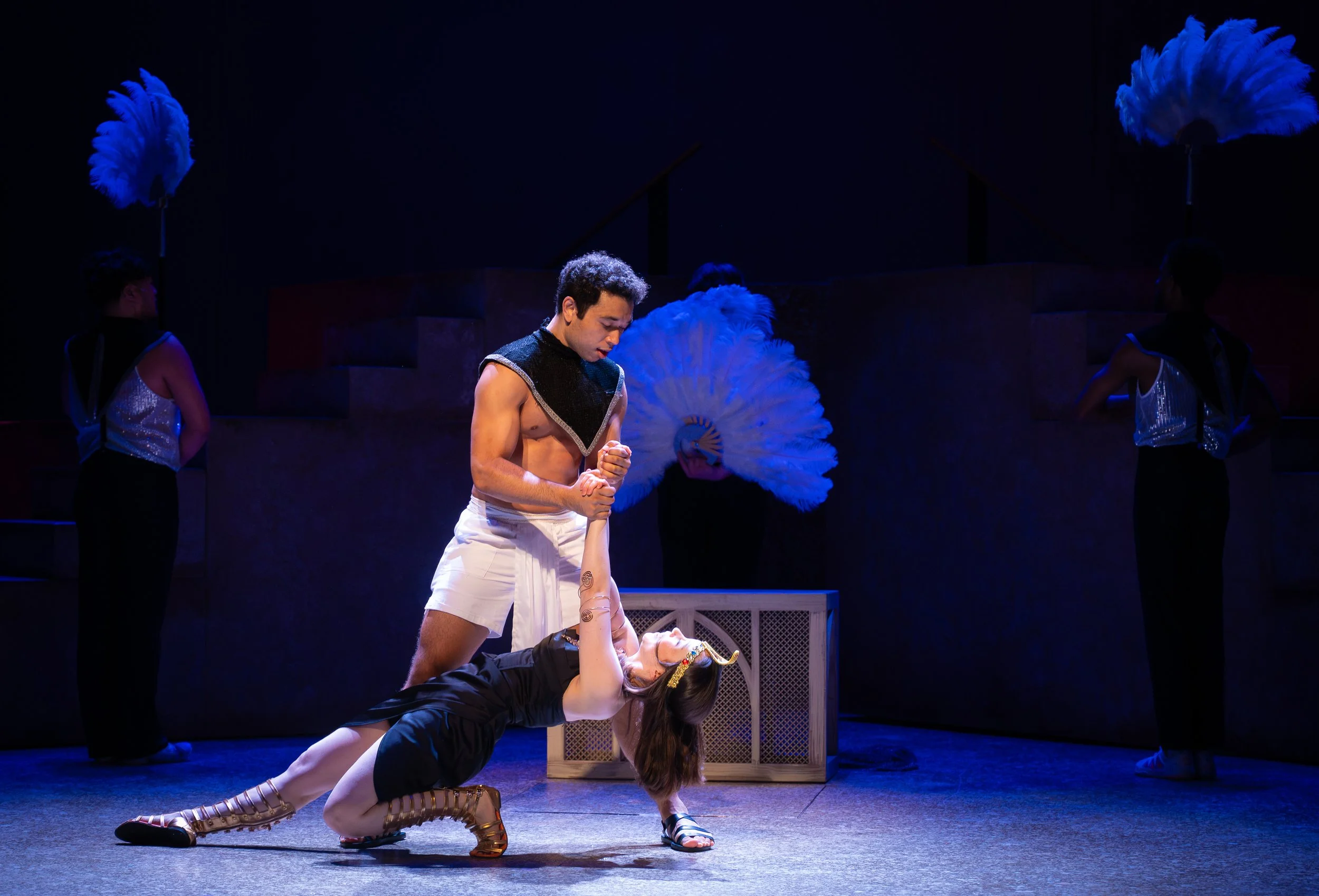
Aaron Alcaraz as Joseph dances with Hannah Balagot as Mrs. Potiphar. (Courtesy/J. Stubbs Photography)
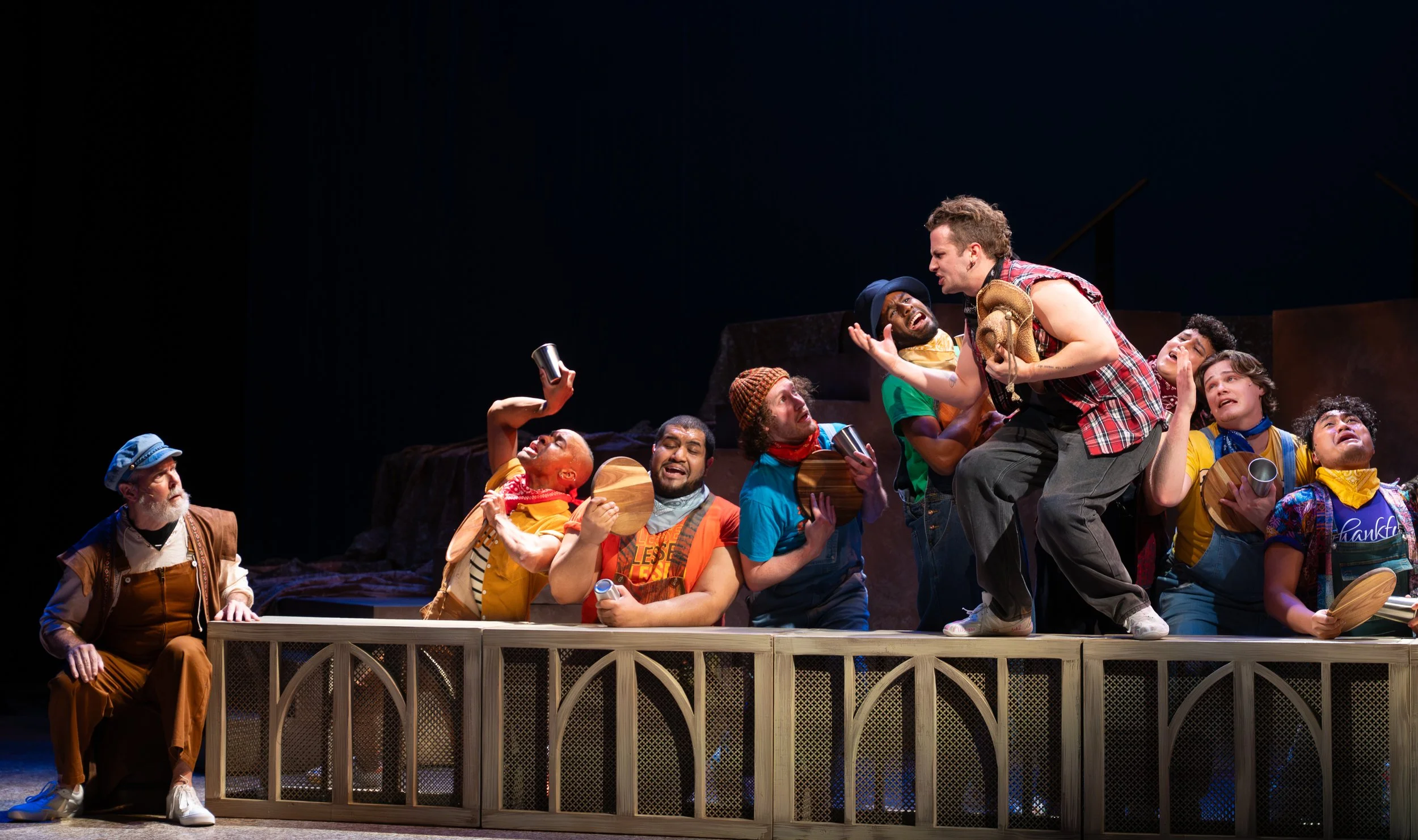
The trick is to take a biblical incident and somehow convey it in a song that is further changed into a parody of some well-known song tradition. Example 1 is the faked account of Joseph’s death that his jealous brothers first give their father: “There’s One More Angel in Heaven.” It is based on Genesis, Chapter 37, wherein Joseph’s brothers sell him into slavery to Ishmaelite merchants but tell their father that he’s been killed by wild animals, showing a bit of his famously gorgeous robe dipped in animal’s blood. It’s all done here, however, as a parodic country/cowboy tune (with local actor John Cauthen playing the father, Jacob, also known as Israel).
Next, our story line switches to what’s happening with Joseph (the wonderful young Aaron Alcaraz, one of five Actors Equity leads in our Virginia Stage Company show). A quick costume change meanwhile puts Cauthen into the parallel role of Potiphar, an older Egyptian with a younger wife (played by Hannah Balagot). She apparently seduces young Joseph, based on fan dancing songs. (The root of this story is in Genesis 39, where Joseph in fact does not succumb.)
The music is also early club tunes. Joseph is sold away again by a rightly concerned Mr. Potiphar, ending up in an Egyptian jail where he interprets dreams for Pharaoh’s servants (explaining that one will live and one will die). The accuracy of his dream interpretations soon lands him right in Pharaoh’s court as his No. 2 man. Pharaoh (the outrageously good Jay Roberts-Miller, who also plays one of Joseph’s naughty brothers, Reuben) greets Joseph and the audience doing a spot-on Elvis impersonation (with a trim Elvis in gold lamé) while flirting with customers seated in the house.
You see the pattern: biblical anecdote with a song parody in some familiar style. When Joseph was depressed in jail (before Pharaoh discovered his talent), we get a cheerleading parody song: “Go, Go, Go Joseph.” When the focus switches back to the land of Canaan (suffering a famine because they do not have Joseph’s Egyptian rationing system), we get a parody of an Edith Piaf song, here titled “Those Canaan Days.” We next get a calypso parody (“Benjamin Calypso”) so outrageous that we’re not at all surprised to see our singers doing a bit of limbo action under a rod. Any necessary bridging song narration is performed by our Narrator (winsome, matter-of-fact Elisa Galindez). The songs themselves are mostly done by an ensemble of those actors first appearing to us as Joseph’s 11 brothers.
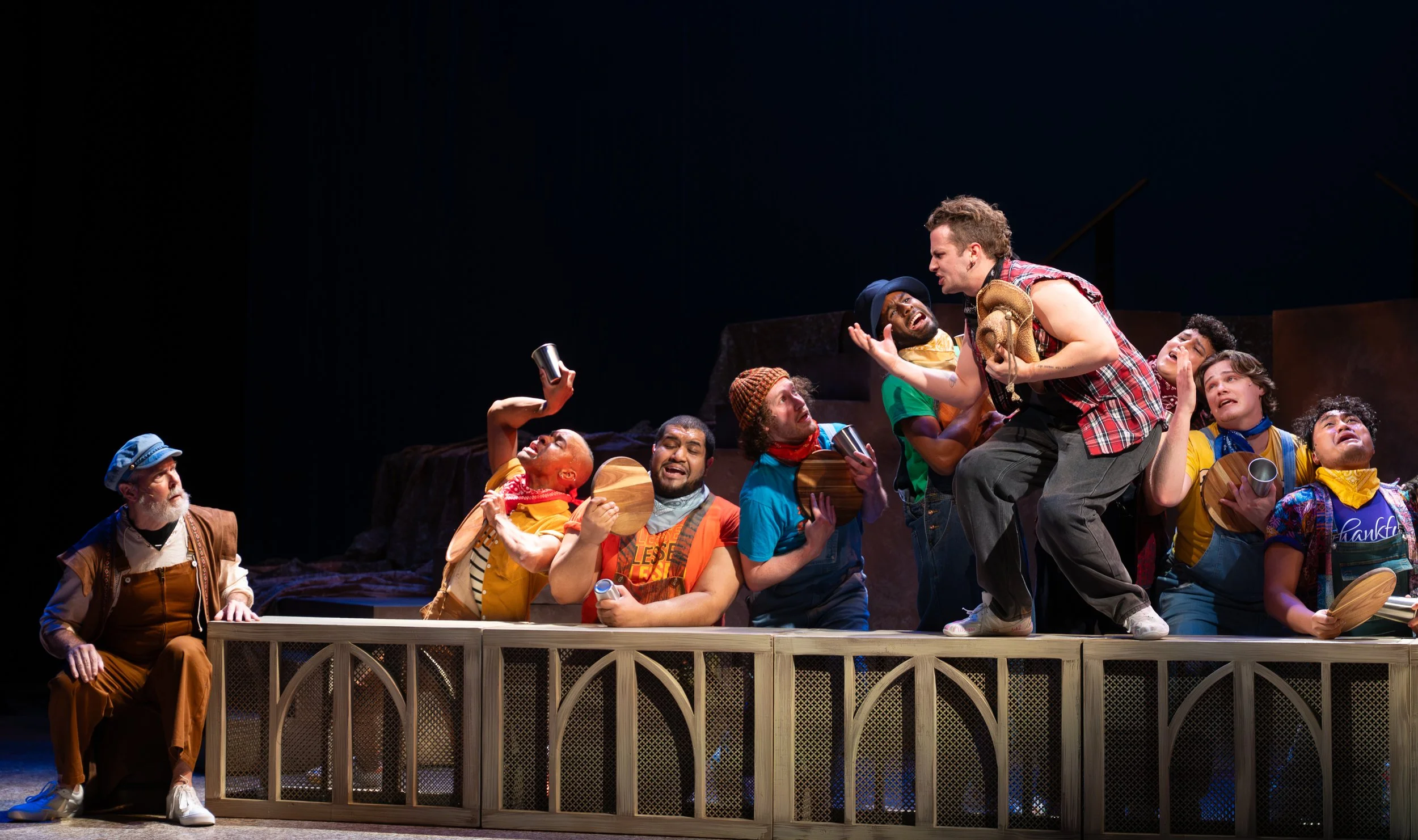
John Cauthen, left, as Jacob is told a lie about his son Joseph having been killed by wild beasts. (Courtesy/J. Stubbs Photography)
Since long before Dr. Benjamin Spock’s 1946 book on child care and parenting, people have known that parents shouldn’t show preference for one child over another. The last straw for Jacob’s children not so favored came when Dad bought his favorite, Joseph, an amazingly beautiful “coat of many colors,” which he wore with strutting pride. The results, as all good Bible readers know, is the initial, nearly homicidal attack on Joseph by his resentful siblings.
But let’s focus, a moment, on the “amazing technicolor dreamcoat” itself, the precipitant for our evening’s entertainment and a hallmark costume/prop for any production. The VSC coat itself (which is miraculously reassembled in the finale from its former status as bloody rags) was created by Jeni Schaefer, costume designer at VSC, in partnership with Meg Murray, costume shop manager. They used fabric pieces called “tumblers,” many of which bore writing or drawings from Virginia Stage theatergoers (the artwork having been solicited and done throughout the season). The results are, to say the very least, spectacular, with the show’s final scene alone worth many a shekel (this show’s currency of choice). I should say no more lest it spoil one’s glee.
The show’s final (and finale) song is perhaps the best known of its score: “Any Dream Will Do,” a curious lyric that makes better sense on further contemplation (aided by the remarks of Quaintance, Panitz and Cowen). It’s not a question of whom Daddy’s or Pharaoh’s favorite will be. It’s not a question of whose dream should be chosen for fulfillment. The life-affirming “message,” if we must call it that, is really that any dream will do, just as long as it’s life-affirming and not some nightmare of narcissism.
I will leave you with a good biblical joke told by Quaintance as the post-show session broke up. First recall that it’s his Job One to select plays that fill both the hearts and seats in the Wells Theatre, preferably at the same time. To this end, he joyfully recited a biblical verse, Genesis 41:55.
His message unto us all: “Go unto Joseph.”
My further modernized and specified version: Go see “Joseph and the Amazing Technicolor Dreamcoat.” And do it soon.
Page Laws is dean emerita of the Nusbaum Honors College at Norfolk State University.
If you go
When: 7:30 p.m. Wednesday through Friday; 2 and 7:30 p.m. Saturday and Sunday; with more shows through March 29
Where: The Wells Theatre, 108 E. Tazewell St., Norfolk
Tickets: Start at $15
Source: https://www.pilotonline.com/2026/03/18/joseph-technicolor-dreamcoat-review/