By Page Laws
Note: This review was written and submitted before the start of the recent Israel-Hamas war.
___
As Tevye the dairyman notes, it is really risky to play the fiddle while perched atop a roof. The title of the great American musical in which he’s the star alludes to Marc Chagall’s painting and the fact that Jews have long had to conduct their religious life and culture under conditions as precarious and nomadic as any people on Earth have had to bear.
So why play fiddle up there, in constant danger of a deadly fall?
Tevye — masterfully performed by John Payonk in Virginia Stage Company’s “Fiddler on the Roof” — answers that with the show’s rousing first number: “Tradition.”
Jewish life has long been balanced between millennia-old religious beliefs and customs that unite the people and the need to grow and change — accepting women, for instance, as fully formed human beings, capable of making their own decisions about, say, marriage partners. Sorry, Yente (the frustrated matchmaker, played by Jacqueline Jones)! Women have rights, too!
So, precarity/change is the theme, and this show’s Tevye is a dream.
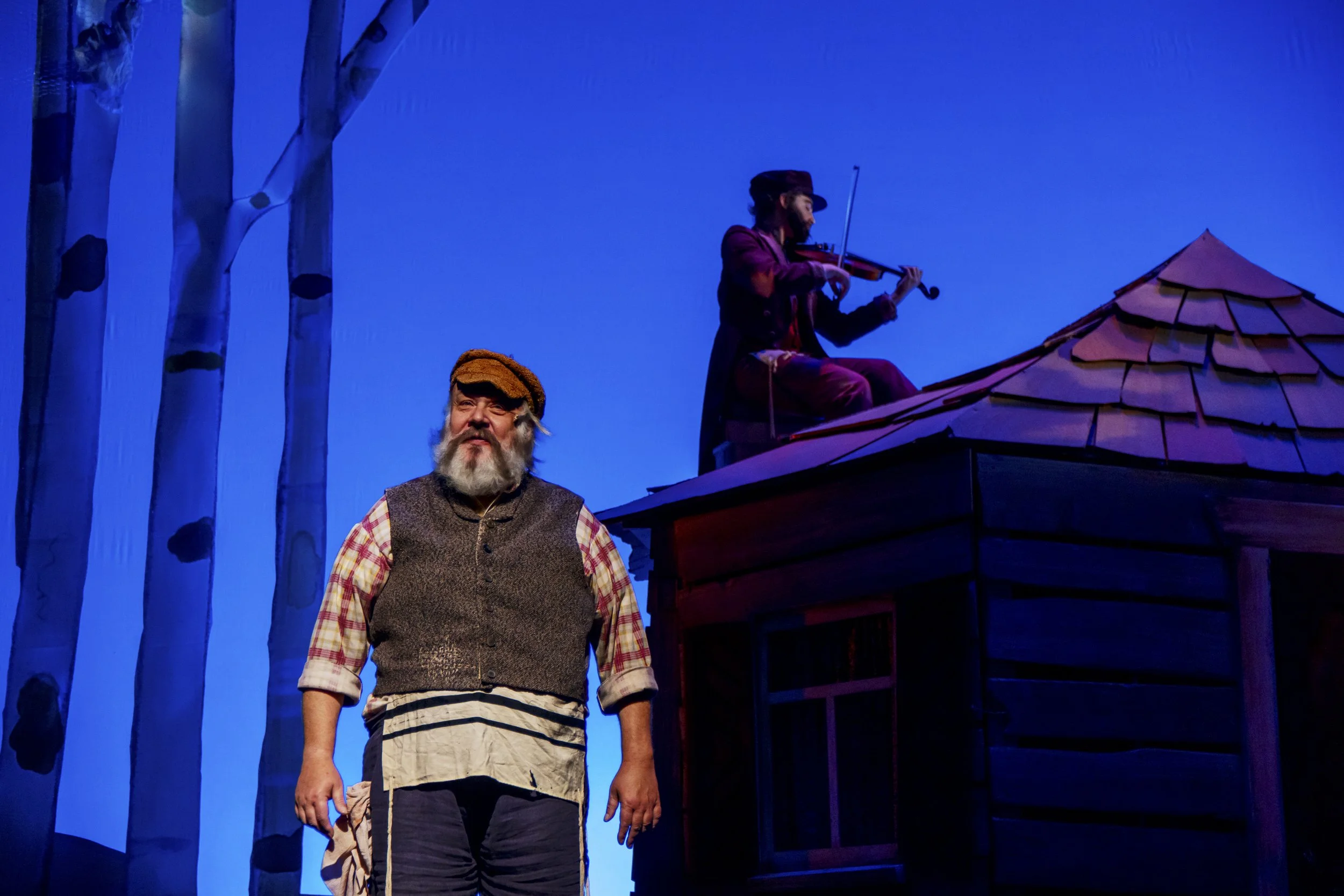
Payonk has a booming baritone coupled with operatic finesse and resonance rich enough to raise the roof of Norfolk’s Wells Theatre, especially as stoked by the brand-new sound system (new seats, too). He also has the comic timing of his best Borscht Belt predecessors — a must for carrying on his soliloquies with God and impromptu mangled citations from “The Good Book.” He’s a man blessed and cursed in having five daughters (cursed in that he has no dowry funds to marry them off). But more on his family and supporting cast later.
The pandemic has made times precarious for theater, but it’s not that risky for the VSC to have chosen what some may consider a chestnut of theater repertory. Especially with the show being generously backed by the United Jewish Federation of Tidewater and the Simon Family Jewish Community Center. This first-time producing partnership has also provided top-notch, pre-show lectures by Rabbi Michael Panitz of Temple Israel along with a showing of the film “Fiddler: Miracles of Miracles,” which documents the show’s provenance and even features an interview with this production’s director, Gary John La Rosa — a friend of “Fiddler” lyricist Sheldon Harnick, who died in June. Here La Rosa duplicates the original choreography of Jerome Robbins, with some success. (He has even directed Chaim Topol — the famous Tevye of Norman Jewison’s 1971 film and many subsequent stage incarnations — in a celebration of the 50th anniversary of the 1964 Broadway version.)
The original source of “Fiddler” is a considerably darker collection of short stories, written about 1894 and later, about Tevye the milkman by Yiddish writer Sholem Aleichem. They’re set around 1905 during pogroms in czarist Russia. In 1906 he fled Ukraine — then a region of Russia called the Pale of Settlement, in which Jews were allowed to live — and eventually settled in New York. (As for his name, it’s a pen name, the greeting “Peace be with you”; he was born Solomon Naumovich Rabinovich.)
Some, including Panitz, have called the musical ”Sholem Aleichem Lite,” referring to its assimilationism and relatively benign conclusion: quiet reconciliation between Tevye and his daughter Chava (Amelia Burkley) who has married outside the faith. This is prompted, of course, by the forced scattering of the entire community of the shtetl Anatevka. Panitz’s overall evaluation of the show is, however, far more measured, especially in his scholarly article “Fiddler on a New Roof,” inspired in part by the 2018 Yiddish-language staging with Joel Grey: “Fidler afn Dakh,” which Panitz calls “more frankly ‘Jewish’” in tone.
Most critics agree that “Fiddler” is a canonical, great American musical that belongs in the worldwide repertory. So it’s really a matter of how good a Tevye and supporting cast can be assembled.
In this case, Payonk nails Tevye, and his supporting cast supports him, using the mix upon which many regional theaters rely — namely, imported Actors Equity members (five here), most often for the leads, and more local community actors for the ranks. Tevye’s special imaginary friend, the Fiddler, is played, for example, by Velkassem Agguini, a violinist at the Governor’s School for the Arts, who does some of his own fiddling for the whirling, cavorting, nonspeaking role. Golde, Tevye’s not-so-long-suffering wife, is Eva DeVirgilis. She maintains her kosher home with panache, modeling the proper wife and mother for all she’s worth. Tzeitel (Ally Dods), the eldest daughter, has inherited her mother’s gumption and her father’s almost Socratic nature.
Tzeitel rejects the matchmaker’s choice of Lazar Wolf (Scott Wichmann), the wealthy (by village standards) butcher who’s none too pleased by it. Tzeitel chooses, instead, Motel the tailor (Greg Dragas), dirt poor but rock solid in a crisis. Daughter No. 2, Hodel (Mia Bergstrom), is the family intellectual who chooses another thinker to wed. He’s Perchik, the student revolutionary, well rendered by Nathan Matthew Jacques. It is he who helps the hidebound citizens of Anatevka begin to see that change is coming, and fast. The third daughter, Chava (Burkley), breaks even more definitively with her family and people when she chooses to love a Russian gentile named Fyedka (Timothy Wright).
Other familiar local actors — Matt Friedman as Mordcha the innkeeper, John K. Cauthen as the rabbi, Scott Rollins as the constable — plus a lively handful of child actors (Gavin and Jasper Gayer, Ellie Madelyn Ruffing and Stormie Treviño) round out some of the large cast.
The set and costumes, while solid, look very much like the dozens of touring versions constantly moving across stages worldwide. There are wigs and male facial hair galore, most seemingly in accordance with Jewish custom of the time but some that looked (intentionally?) comical.
Though not directly emphasized in this production, it pays to remember that real Anatevkas in Ukraine may be suffering bombardment as we watch this show or read this newspaper account. Awareness of “Fiddler’s” relevance to the war in Ukraine seems to have somewhat diminished since the last touring production I saw, at the Ferguson in Newport News in March 2022; the cast dedicated it to the people of Ukraine.
But this should not detract from the accomplishment of the two Jewish organizations and Virginia Stage Company in putting on a fine “Fiddler,” starring an admirable Tevye. For that accomplishment in still-precarious times, they deserve a heartfelt ”Mazel tov!”