
Review: Share a killer, thriller, chiller night with Virginia Stage Company
In ‘Wait Until Dark,’ our heroine can’t see the con men who come to rob her. Page Laws reviews this remake of a 1960s classic.
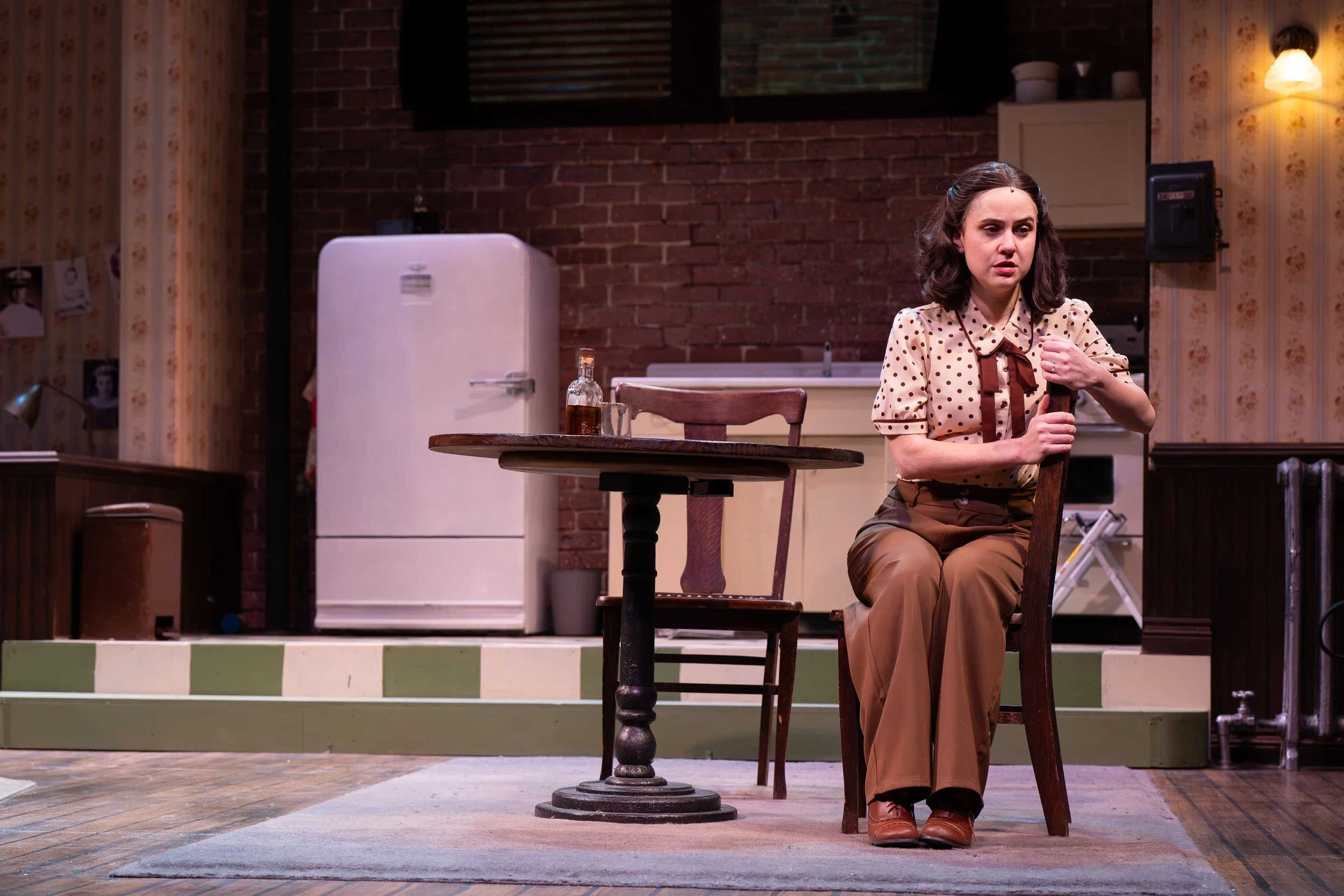
Meredith Parker as Susan considering her situation in Virginia Stage Company’s production of “Wait Until Dark.” (Courtesy of J. Stubbs Photography)
“Why do I have to be the world’s champion blind woman?”
— Susan to Sam in “Wait Until Dark”
___
How appropriate for the weather! A thriller that further chills us, its poor paying audience, to the very bone …
Sam’s immediate answer to Susan’s semi-plaintive, half-joking epigraph line above: “The world is a dangerous place.”
And indeed it is, in this offering by Virginia Stage Company, with sure-handed frequent guest Mark Shanahan directing a nimble cast of six, five of whom are Actors’ Equity Association members.
In the absence of Sam, Susan’s husband (he’s away on business the bad guys have falsely concocted for him), their apartment becomes a veritable headquarters for murder and mayhem at the hand of three particularly nasty crooks who are also skilled con artists.
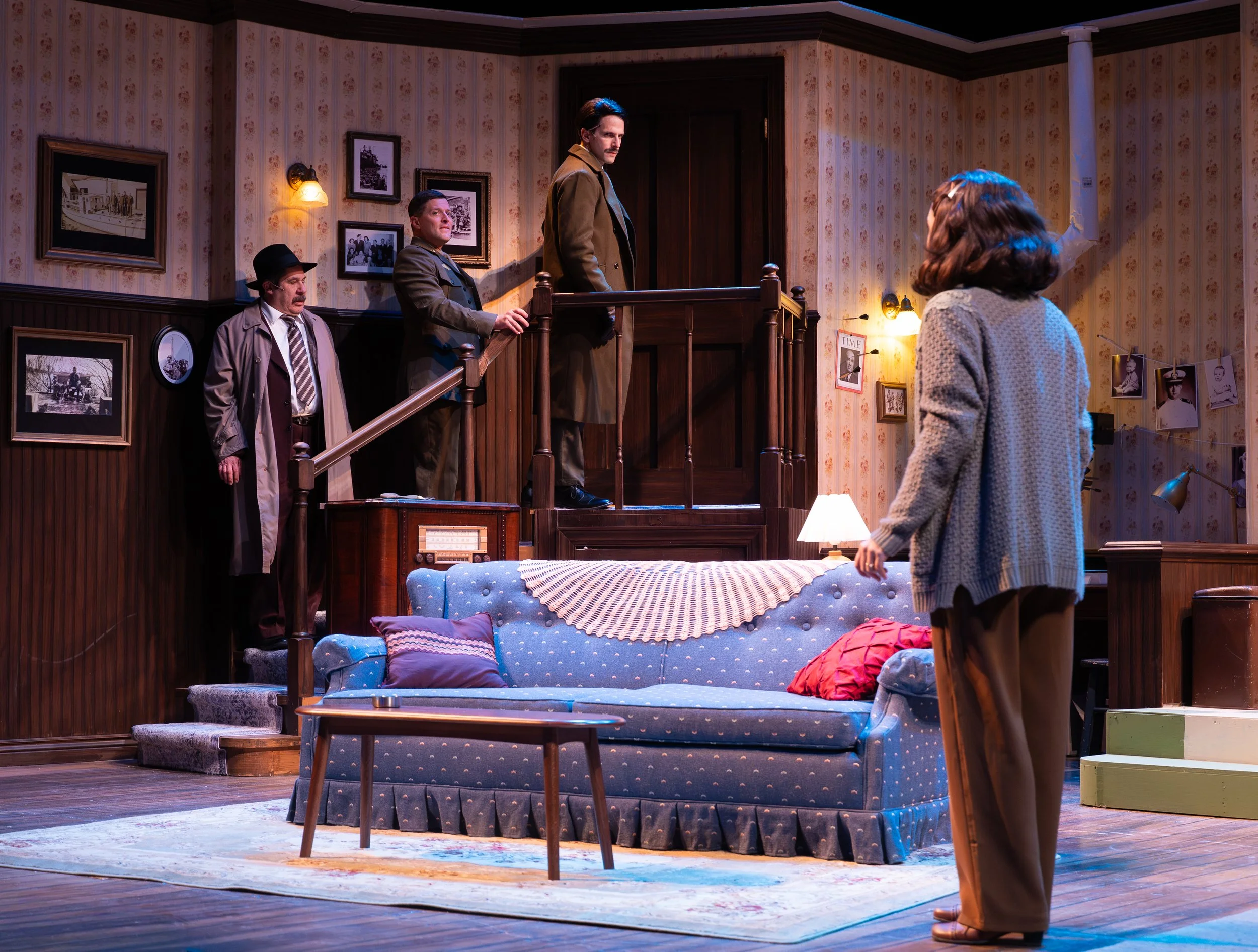
In Virginia Stage Company's "Wait Until Dark," Susan's three supposed rescuers, all frauds: police Sgt. Carlino, left (Triney Sandoval); Army Lt. Mike Talman (Steve Pacek); and Roat (Seth Andrew Bridges), with Susan (Meredith Parker) in the foreground. (Courtesy of J. Stubbs Photography)
Here, only in part, is how it’s done.
Sympathy, first, is due to anyone who must play Susan (here it’s Meredith Parker) in the wake of the original film actor who did: It was, of course, always elegant, deeply winsome Audrey Hepburn in the original 1967 film version by Frederick Knott (who wrote the screenplay and also “Dial M for Murder,” 1958). Jeffrey Hatcher adroitly adapted Knott’s “Wait Until Dark” into this, our stage version, first performed in 2013. (Knott’s stage version was first mounted on Broadway in 1966.)
Slender and fragile as she was, Hepburn is a tough cookie to compete with, once she’s put her indelible stamp on a role. Think, for example, “Breakfast at Tiffany’s” (1961). Now picture someone else as Holly Golightly. Impossible, right? Hepburn likewise put her career stamp on Susan in “Wait Until Dark.”
Meredith Parker, one of the Equity pros in this Virginia Stage production, has herself an additional, very story-relevant challenge, besides performing in Hepburn’s shadow. Parker, as her bio notes, is low-vision herself, a condition acquired in adulthood with which she must cope daily, both on and offstage. She manages very well, as do all her acting partners, including the one non-Equity performer, young eighth grader Wyllow Smith, who has already acted in two years’ worth of VSC’s “A Merry Christmas Carol” (adapted from Dickens’ classic by this production’s director, Shanahan). Smith plays Susan and Sam’s upstairs neighbor whose part-time job it is to clean a bit and to fetch groceries for Susan, especially when Sam is busy with his photography job. This girl, Gloria, is drawn dangerously into the plot despite Susan’s best efforts to shield her.
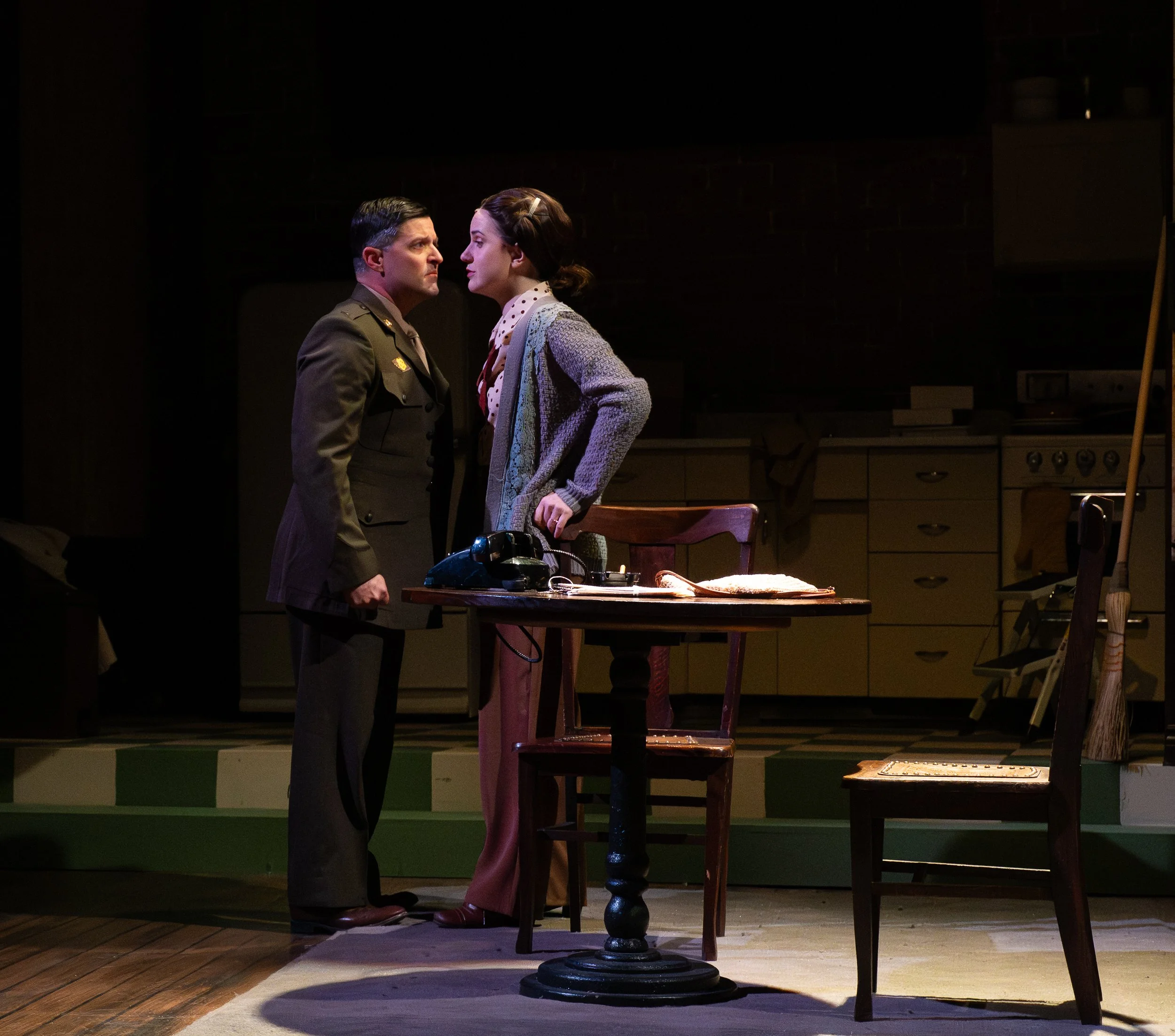
Mike (Steve Pacek) and Susan (Meredith Parker) in a confrontation after her suspicions have been raised, in Virginia Stage Company's "Wait Until Dark." (Courtesy of J. Stubbs Photography)
It is Sam (Mike Gerbi at Virginia Stage Company) who unwittingly draws the trio of criminals down on him and his wife, when Lisa, a female criminal whom we meet only as the show’s first onstage corpse, hides a valuable doll in his valise while both are strangers on a train. Lisa knows where her compartment companion lives because of a tag on his luggage. She plans to retrieve the doll and its mysterious contents (heroin in the original film, but something else in this stage version) there at Sam’s house, after she evades her train station pursuers. She does try, but she is killed and her corpse hidden (in the apartment!) while Susan and Sam are out (pre-show for the audience). The killer does not find the doll, however, setting off the elaborate three-man scam to unearth and retrieve it.
Sam and Susan are clueless about the doll’s contents until well into the evening, after the trio of criminals is exposed. They consist of Sgt. Carlino (Triney Sandoval), a former corrupt cop once imprisoned for his activities and now impersonating a cop to deceive Susan. Then there’s a particularly threatening con man named Roat (Seth Andrew Bridges) who plays both a young man innocently searching for the “misplaced” doll and that young man’s father. (The actor’s mistake is in wearing the same squeaky pair of shoes when playing both father and son.) The third con man is Mike Talman (Steve Pacek, a regular guest artist at Virginia Stage), pretending to have been a comrade in arms of Sam during his time fighting in Italy. Talman’s actions are the unkindest cut of all (to the innocents in the cast and us innocents in the audience). His perfidy is the last to be discovered by Susan, who has trusted him as an ally.
And what gives him away?
It’s the use of Sam and Susan’s basement apartment window blinds as a signaling device among the criminals as they work out of an empty milk truck parked outside, using a nearby phone booth for calls.
A blind woman can’t see them working her venetian blinds, right?
No, but she can eventually hear them.
The villains in the 1967 movie version (the one with Hepburn) were all actors generally more associated with playing “good guys” — for example, Jack Weston played Carlino (here at Virginia Stage, Sandoval). Alan Arkin played the evil Roat in the film (here, Bridges); Richard Crenna played Mike (Pacek for us). Efrem Zimbalist Jr. played Susan’s 1967 photographer husband Sam (our Gerbi), possibly a philanderer.
The great strength of the Virginia Stage production is the professional poise and skill of all these five Equity standouts, and even of young Smith as Gloria. I found her much more believable and appealing than her film forerunner, Julie Herrod.
The period nature of the play’s 1940s setting is fun for theatergoers. This includes on-set kitchen appliances (remember defrosting refrigerators? Talk about horror!) and old-fashioned dial phones, of course. The double-entendre usage of the window blinds to tip off (inadvertently on the criminals’ part) a blind woman works equally well in both film and stage.
It’s somewhat amazing that what audiences remember most about the original film is the brief part played in total darkness (good for Susan who can navigate it) and partial darkness (bad for Susan, because her enemy Roat can still see and is enraged and trying to kill her).
The actual periods of total darkness in our play version seem very brief — but the results are truly frightening, since we all share it there in our Wells Theatre seats.
The acting is all one can hope for; the set and tech were smack on; the background music was sometimes a bit off-putting — silence might have worked better in some cases. Don’t be put off by the virtual torrent of plot elements spewing at you from all the characters, both good and evil. Some plot elements are extraneous … or are they?
So, theatergoers, man (and woman) up. Bundle up. Don’t be afraid of the dark.
In fact, just wait for it.
Page Laws is dean emerita of the Nusbaum Honors College at Norfolk State University. prlaws@aya.yale.edu
If you go
When: 7:30 p.m. Wednesdays through Sundays, 2 p.m. Saturdays and Sundays, through Feb. 15
Where: The Wells Theatre, 108 E. Tazewell St., Norfolk
Tickets: Start at $15
