
American Theatre Magazine's Jonathan Norton's Moments of Change | Malcolm X and Redd Foxx Washing Dishes at Jimmy’s Chicken Shack in Harlem
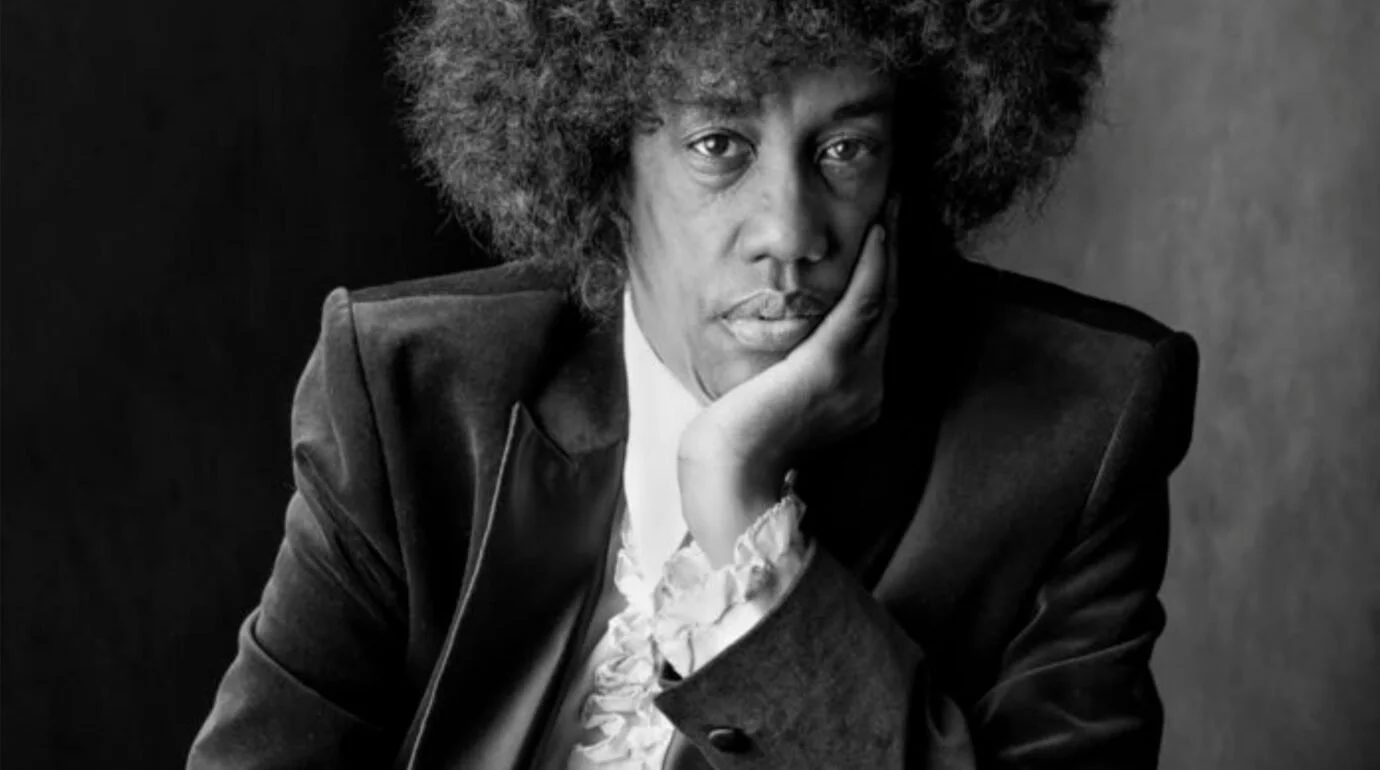
Jonathan Norton. (Photo by Kent Barker)
Jonathan Norton’s Moments of Change
The Dallas-based playwright and theatre leader has an eye and ear for detail, including in his new play about Malcolm X and Redd Foxx.
By Katy Lemieux
Playwright Jonathan Norton is sitting at a long bench at a table inside a Starbucks in posh West Village, Dallas, when I walk in to meet him. From our email exchanges, I know he’s just finished a meeting for the Dallas Theater Center’s (DTC) production of Noises Off, splitting his time between his roles as interim artistic director and playwright-in-residence. He’s been working double duty like this since AD Kevin Moriarty transitioned out of the role and into the executive director role in 2024.
Norton has been a constant in the Dallas arts scene for nearly as long as I’ve written about it. To me, he first appeared as a breakout talent, someone who seemed to burst onto the theatre scene fully formed, but in fact, he’s been nurturing his writing voice in Dallas his entire life. A native of the Pleasant Grove neighborhood, he graduated from Dallas’s elite public high school for the performing and visual arts, Booker T. Washington (think the school from Glee, minus the IP infringement), and his career trajectory has skyrocketed in the last decade. Though he’s had productions in other cities, three of his plays—penny candy, Cake Ladies, and I AM DELIVERED’T—have had their world premieres here at DTC.
This is my first time sitting down with the now-legendary local playwright, and I have to admit I’m somewhat intimidated. Which is silly, because I can tell right away that he is someone who gives his entire attention to the subject in front of him, and his quick and kind smile makes me feel like we’ve known each other for years. He pulls out of his bag a playbill for DTC’s 1986 production of Noises Off and says, “Look at this!” He tells me about his love for old playbills, recalling that, as a child, he spent hours making his own homemade theatre playbills, down to the tiniest details.
We’re meeting to talk about his new play, Malcolm X and Redd Foxx Washing Dishes at Jimmy’s Chicken Shack in Harlem, a co-production among four American theatres that serves as the centerpiece of 2025-26 seasons at Arkansas’s TheatreSquared (which first commissioned the play), Pittsburgh’s City Theatre Company, Virginia Stage Company in Norfolk, and here at Dallas Theater Center, where it opens in May. The first staging was last October at TheatreSquared; the rest are in the coming months, including DTC’s run in May.
I have lots of questions about all of his work, and there’s a lot of material to cover, but Norton immediately breaks into a big smile and starts talking about his current obsession. I have no idea where this is going, but he’s already hooked me. His excitement is contagious.
“Have you seen those YouTube videos of students filming their reactions to college admittance or rejection letters?” he asks me. “I am obsessed with them.”
It may be the last thing I expect this brilliant playwright to say. I laugh, but Norton defends his fascination. “The drama in those videos!” he says. “It’s so authentic. It’s a look at inner family life we rarely see.” Norton describes the videos, which often feature multiple generations crowded together, with parents, grandparents, and siblings peering over one another’s shoulders. Sometimes the outcomes are joyful, other times crushing. “It resonates with me as a theatre person,” he continues. “You learn to deal with disappointment because you keep experiencing it.”
He tells me, smiling, how he lives vicariously through the teens in these videos: holding out hope for them, watching how they process the happy or not-so-happy news. “It’s very comforting, and very human,” he tells me, and links this to his own journey: “As I’ve grown older, I’ve put a lot of perspective on my past.” One conclusion: “Everyone wants something. Wanting something very badly kind of levels the playing field.”
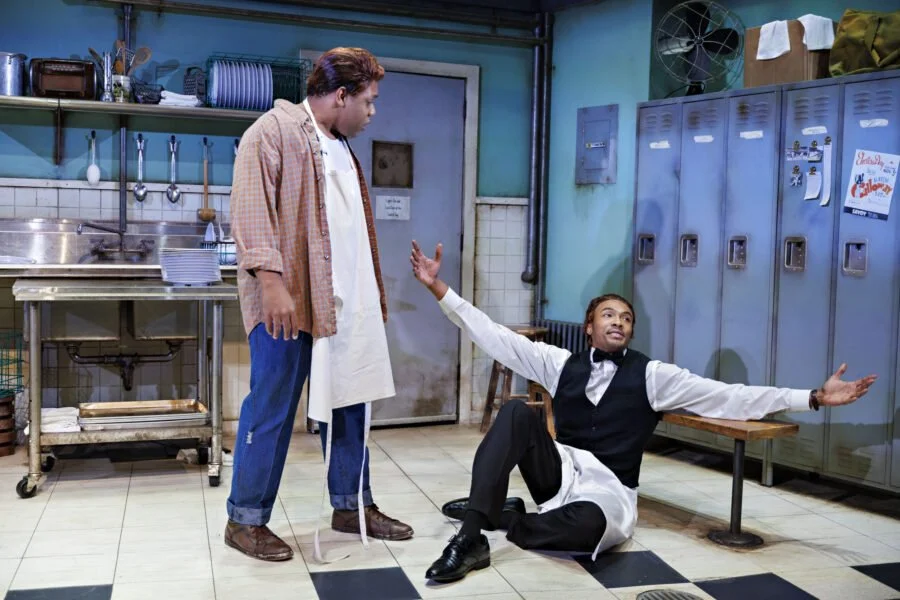
Trey Smith-Mills as Foxy and Edwin Green as Little in ‘Malcolm X and Redd Foxx Washing Dishes at Jimmy’s Chicken Shack in Harlem’ at TheatreSquared in 2025. (Photo by Wesley Hitt)
The idea for his new play sprang from a passage Norton came across in The Autobiography of Malcolm X about how the Civil Rights icon had once washed dishes alongside, and became close friends with, a young John Elroy Sanford, who would later become comedian Redd Foxx, of Sanford and Son fame. Each had earned the nickname “Red” for their red hair (X was “Detroit Red,” Sanford “Chicago Red”). In his book, X called Sanford “the funniest dishwasher on this earth.”
Norton had been looking for a way to write about Malcolm X alongside another prominent figure, Maya Angelou, and briefly considered Harlem fashion icon Dapper Dan as a counterpart to X. But the unlikely friendship of X, née Little, and Foxx, née Sanford, was too good to pass up. Their rapport grabbed his attention; Norton loved the idea of exploring who each had been before the world came to know them as someone else. He also saw something besides a before-they-were-famous gimmick: the chance to portray a close friendship between two Black men.
Longtime Dallas actor and director vickie washington, an early mentor of Norton, worked with both TheatreSquared and DTC, and introduced the play’s collaborators to him, including Dexter J. Singleton, TheatreSquared’s director of new play development. Malcolm X and Redd Foxx tackles a big subject—Singleton, who directed the premiere there, called it a “signal play,” and commissioned it from Norton in 2023 after the theatre “all fell in love with him” when they hosted an early reading of his I AM DELIVERED’T. In fact, Norton was one of TheatreSquared’s first commissioned playwrights. Norton recalls his time in Arkansas as an “oasis” for his writing, as it gave him time to write in the theatre’s open spaces and interact with patrons and staff—skills that may have stood him in good stead in his dual roles at DTC.
As a playwright, Norton is a patient listener, an observer of details, waiting for the moment when the stakes get higher—when a character has no choice but to act. He is also skilled at capturing a sense of place and time, as well as inner looks at family dynamics and everyday human interactions. This makes sense, given the hours he spent watching customers, family, and friends stream in and out of his family’s Pleasant Grove candy shop. He thinks closely about the circumstances his characters inhabit and what each one’s “I want” means.
“I’ve always loved details,” he says. “They’re where the humanity lives.” He’s also a keen observer of family life, having been an only child who spent much of his childhood in the company of adults, in one of the few households in his neighborhood in which both parents were present.
Norton’s deftness at capturing the specificity of place is not unlike that of playwright August Wilson, whom Norton credits with inspiring him to write plays as early as middle school. Around that time, many of Norton’s childhood friends moved away from what was becoming a growing crack epidemic in Pleasant Grove, which left him isolated. Norton loved the way Wilson gave audiences a look into the interior lives of Black Americans, including their conflicts and flaws, through stories rooted in Pittsburgh’s Hill District. It was at Booker T. Washington High that Norton’s playwriting teacher, Elly Lindsay, noted his interest and taught him about plot and structure.
It was his family’s home-based business that initially fueled his writing, as there was never a lack of scenes playing out in his literal living room. “It was a revolving door of characters: customers, family, friends,” he says. “I was soaking up stories all the time.”
It may have been that his house was known as a “safe spot” in a neighborhood increasingly wracked by the 1980s-era crack cocaine epidemic, which hit Black communities hardest and “took out an entire generation of matriarchs,” Norton adds.
“It was a quick, cheap high that destabilized whole communities,” he recalls in a somber tone. “It almost feels like it was intended to do exactly what it did.” Just a decade later, in the 1990s, tens of thousands of children born addicted were in foster care. “Addiction exists everywhere,” he adds, “but crack cocaine tore apart Black communities in ways we didn’t see in white ones.”
Norton’s play penny candy, produced by DTC in 2019, was set in this place and time. Two years later, Dallas-based publisher Deep Vellum released penny candy as its first play title. (Full disclosure: I’ve worked as a fundraiser for Deep Vellum.) Acquiring Norton’s play was an easy decision, said Deep Vellum CEO Will Evans.
“It’s a Dallas story from start to finish, and Dallas is critically underrepresented in literature,” said Evans. “The Dallas of penny candy isn’t Uptown. It’s a reminder that cities have stories, and that anyone can relate to them.” In all his work, Evans said, Norton “plants roots that bridge time.”
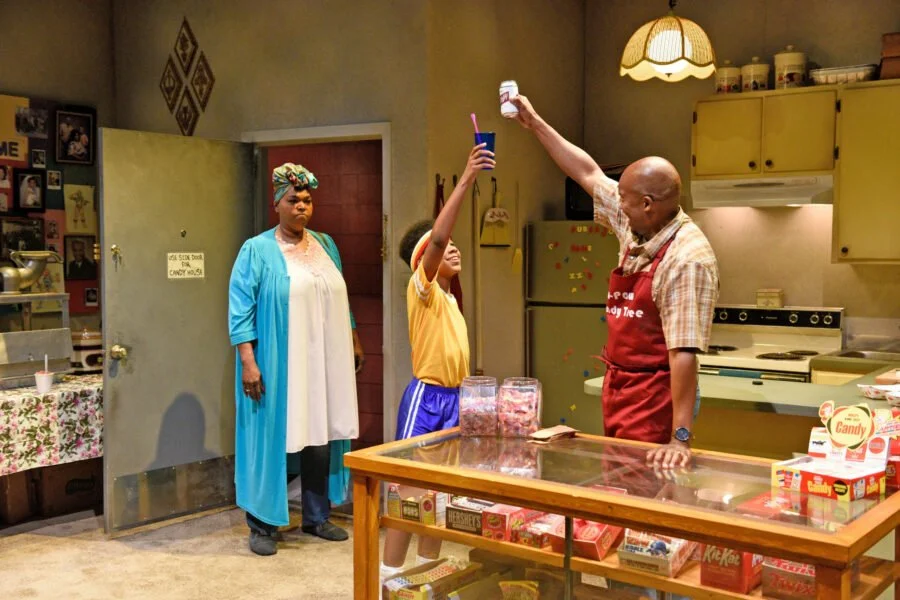
Liz Mikel, Esau Price and Leon Addison Brown in Jonathan Norton’s ‘penny candy’ at Dallas Theater Center in 2019. (Photo by Karen Almond)
It was also in 2019 that Norton became DTC’s playwright-in-residence, following in the footsteps of one of his mentors, Will Power, a rapper, performer, and director who had been DTC’s playwright-in-residence since 2013. Power told Moriarty then that DTC’s next resident writer should be local and should represent Dallas. “A great city needs a voice,” Power told Moriarty at the time, “not just a place where writers live.”
Deep Vellum’s Evans thinks Dallas should be careful not to take Norton for granted. “He’s such a gifted storyteller,” he said. “History only stays relevant when you talk about it.” He sees Norton’s Malcolm X and Redd Foxx as “a perfect synthesis of time and place in history.” This kind of theatre can live not only on the stage but also on the page, Evans added. “The Dallas when Jonathan wrote penny candy isn’t the same Dallas of today, and five years later, it can mean something new. Publishing lets his plays live on, evolve, and keep speaking to new readers.”
Around the same time that he told Moriarty that a great city needs a great voice, Will Power launched a writers group at DTC and identified Norton early on as someone with something special to say. Then, in 2024, Norton stepped into the theatre’s interim artistic director role while the board sought a permanent successor to Moriarty (Jaime Castañeda got the job in mid-December, right after this issue went to press).
Moriarty says he never hesitated about tapping Norton for the job. “Jonathan knows DTC from the inside: our artists, our audiences, and Dallas itself, and he’s always had my complete trust.”
In filling both roles, artistic director and playwright-in-residence, Norton says he has learned what it truly takes to run a theatre company: endless decisions, intricate planning, and balancing artistry with administration. It requires considering many perspectives and wants, alongside season planning and administrative work.
“It’s given me a new understanding of what’s personal about theatremaking and what’s just part of the job,” he says. “All of the departments have to work together.” Thinking of fellow artists who aren’t privy to the inner workings of theatre institutions, he adds, “If I could offer any insider knowledge, it’s that none of the decision-making is personal.”
There are also the challenges of shrinking resources for theatres, which Norton says is one upside for Malcolm X and Redd Foxx’s four-theatre co-production. Beyond sharing the financial burden, a collaboration like this also allows a writer to develop their work in front of many eyes. Collaboration isn’t just a survival strategy; it’s also a way to make the work stronger. Norton says he has particularly loved the times he’s gotten to be public-facing and talk with people about theatre. “The play’s co-production lets the play evolve with different audiences in different regions,” he says.
The time it takes to develop new work is something he’s thought about often during his time as AD. He’s always been in favor of putting artists together to see what can happen. At this new job, he’s also learned a lot about how every component, every detail, matters in theatremaking, and how work across all departments leads to successful overall productions. The attention to detail he brings to his playwriting has also undoubtedly played a role in his work as AD.
Norton says he has carefully scheduled his hours so that he can lead programming at the theatre while also leaving time for his own writing. It’s actually written into his contract that he is a playwright first and foremost, though these roles are not so rigidly separate. Moriarty said that Norton has programmed DTC’s season with a playwright’s sensibility, considering the season’s story arc, the emotional journey it’s taking audiences on, and why the stories matter now.
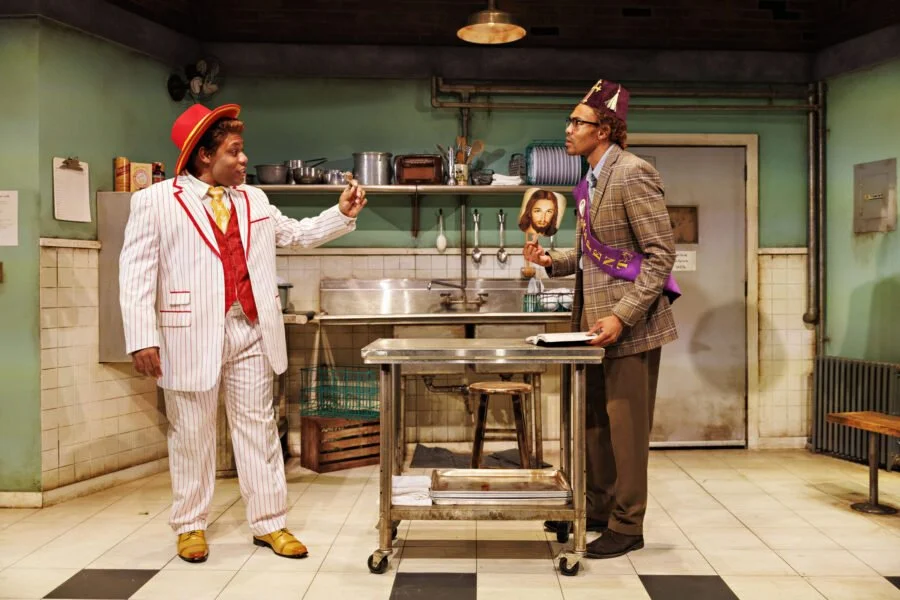
Trey Smith-Mills as Foxy and Edwin Green as Little in Jonathan Norton’s ‘Malcolm X and Redd Foxx Washing Dishes at Jimmy’s Chicken Shack in Harlem’ at TheatreSquared in 2025. (Photo by Wesley Hitt)
Norton’s writing is very rooted in the present, even when it’s set in the past, Deep Vellum’s Evans said. This is also what drew Singleton and TheatreSquared’s artistic director, Robert Ford, to Norton’s work and sparked their interest in commissioning a play about Malcolm X.
“It’s a deeply American story, and that is very exciting,” Singleton explained. “His work is so connected to social and political currents, and there is a lot that he wants us to pay attention to, but he doesn’t lose the rhythm.”
In Malcolm X and Redd Foxx, Norton’s focus on the comedy amid the drama shows his gift for “helping the medicine go down easier,” says Singleton. Set in 1943, the play depicts Little and “Foxy,” two young men toiling in the kitchen of a Harlem chicken shack as they unpack ideas and arguments about the toll of World War II, Harlem’s cultural flowering, and the lack of respect shown to Black servicemen returning from the war. But the play doesn’t let the gravity of its themes drag it down; at its core, it’s a story about a friendship. Though we know who these characters will become, there is great suspense as we watch their ambitions unfold, and true urgency in their conversations as we know a greater fight for justice is looming.
Norton says it’s vital that we see these two powerful Black men at the center of the story and embrace their vulnerability, all the better to share in their fear, joy, and anger, and to make room for their “wanting” alongside ours. It’s a very human way to connect ourselves to these major historical figures.
“He writes complex, contradictory characters that actors love to inhabit,” said Moriarty. “And he’s a gifted comedic writer. Malcolm X and Redd Foxx is lean; the emotional stakes land with a quiet punch. It’s about friendship, transformation, and the small choices that alter history.”
The actors Trey Smith-Mills (Foxy, a.k.a. Redd Foxx) and Edwin Green (Little, a.k.a. Malcolm X) are both alumni of the University of Arkansas and have been playing the roles since they were first cast in the staged reading. Singleton said the rapport the two actors have as friends was evident onstage, and the relationship among the four—the two actors and Norton and Singleton—gives the play its heart.
For Bob Ford, TheatreSquared artistic director, it is the vulnerability that Norton finds in the relationship of Malcolm and Redd that makes all the difference. “Something very powerful happens at the end,” Ford said, careful not to spoil it. “Dex and Jonathan have found something in just a few words that reminds you who Malcolm and Redd are. They’re just human.”

Robert Barry Fleming and Jonathan Norton at a 2023 TheatreSquared workshop. (Photo courtesy of TheatreSquared)
Norton isn’t a historian, but as a storyteller, he wants to invite audiences into hidden parts of the past, where small but vital details live. He recalls a moment after the publication of penny candy that stayed with him. Deep Vellum bookstore director Riley Rennhack leads a medical humanities book club for pediatric residents at Dallas’s UT Southwestern Hospital, based on research showing that reading fiction can help build empathy. When they read penny candy, Norton says, several residents saw connections between the families depicted in the play and the parents of their current patients. “It gave them context,” Norton says. “A missing piece of understanding about how addiction wiped out a generation of mothers allowed them to make connections in their patients’ care plans. That’s what storytelling can do.”
Norton remains full of stories. He laughs at the memory of his homemade playbills, the worlds contained within them, and how his mother eventually tossed them out. I tell him I understand why he loves those college admissions videos: He is very interested in people at moments of change.
By coincidence, Norton recently came across a college admissions reveal video featuring the daughter of his mentor, Will Power. Norton has known the family for years and has watched the kids grow up. When “baby” Sophia’s video popped up on his screen, it filled him with joy.
In the video, Power’s daughter, Sophia Teyolia, is on FaceTime with her dad, watching from another city as his voice floats through the phone, cheering her on with fatherly encouragement. A tiny look at the interior life of this family feels like a full-circle moment for Norton, as he witnesses his mentor and family together in a moment of closeness. It’s clear what he sees in these videos: The stakes remain personal and high. The hopes of one family form a bridge between personal histories and the broader world. Surrounded by people who love her, Sophia Teyolia’s “I want” becomes a collective wish. That’s where the story begins.
Katy Lemieux is a writer living in Texas. Her work has been seen in The New York Times, Esquire, and Texas Monthly, among others. She co-owns Talking Animals Bookstore outside of Dallas.
Source: https://www.americantheatre.org/2026/02/27/jonathan-nortons-moments-of-change/
